
Marina has real needs. Marina needs modern public facilities. It also needs a broader strategy for creating the revenue to pay for them.
Marina’s needs are real. The question is whether a permanent new tax on residents should be the first major strategy, or whether our community should first develop a comprehensive plan for economic growth, developer responsibility, strategic investment and responsible cost reduction.
Our police officers, firefighters, emergency personnel and city employees deserve facilities that are safe, functional and capable of serving a growing community. Residents deserve reliable emergency response, well-maintained streets and public buildings that meet modern safety and accessibility standards.
Those needs should not be minimized or dismissed.
But acknowledging the need does not mean we should stop asking questions about how we pay for it.
TL;DR
Marina needs safe, modern public-safety and civic facilities, but Measure Q would impose a permanent 7% utility tax on residents and businesses, with revenue going into the General Fund. Before approving another tax, Marina should fully explore alternatives, including aviation-led job growth, stronger developer contributions, strategic airport and commercial leasing, tourism, grants, phased construction and responsible cost reductions. The goal is not to dismiss Marina’s needs, but to build a stronger economy capable of paying for them.
What Marina’s Measure Q Would Do
On November 3, 2026, Marina voters will consider Measure Q, formally presented as the City of Marina 911 Emergency, Public Safety and Community Services Measure.

The City projects Measure Q would generate approximately $3.83 million annually. Its published estimates of the average household cost have changed, however. City materials have variously cited approximately $250, $327.50 and $344.40 per year. The City’s current Measure Q webpage estimates about $28.70 per month, or $344.40 annually. Residents would benefit from seeing the underlying calculations used to determine that average.
The City has emphasized public safety, emergency response, streets and the replacement of aging police, fire and civic facilities. Those are important priorities.
However, Measure Q is legally structured as a general tax. The revenue would be deposited into Marina’s General Fund and could be used for other general City services. The tax would also remain in effect until ended by voters.
Before Raising Taxes, Have We Explored Every Alternative?
Before asking every household and business in Marina to pay more each month, I believe we should have a broader community conversation.
Have we fully explored what Marina can build, grow, lease, attract, negotiate and reorganize before adding another permanent tax?
The Question Is Not Whether Marina Has Needs
The City estimates that replacing or modernizing its priority facilities could cost approximately $69.3 million. It reports having secured about $19.3 million through grants, impact fees and other sources, while projecting that approximately $58 million may still be needed by the anticipated construction date because of inflation and rising construction costs.
That is a significant challenge for a small city.
Marina’s budgeted General Fund revenue for fiscal year 2025–26 is approximately $38.53 million, while ongoing operating expenditures total approximately $37.68 million. Police and fire are budgeted at a combined $16.82 million, representing approximately 44.7% of General Fund operating expenditures.
The City projects approximately $10.79 million in property-tax revenue, $10.36 million in sales-tax revenue, $6.49 million in transient occupancy tax, $1.91 million in business-license tax and $1.76 million in other taxes.
City of Marina General Fund and Projected Tax Revenue, FY 2025–26
| Revenue Category | Projected Amount | Share of General Fund Revenue |
|---|---|---|
| Total General Fund Revenue | $38.53 million | 100% |
| Property Tax | $10.79 million | 28.0% |
| Sales Tax | $10.36 million | 26.9% |
| Transient Occupancy Tax | $6.49 million | 16.8% |
| Business-License Tax | $1.91 million | 5.0% |
| Other Taxes | $1.76 million | 4.6% |
| Total Listed Tax Revenue | $31.31 million | 81.2% |
Budget context: Police and fire account for approximately 44.7% of Marina’s budgeted General Fund operating expenditures. The percentages above compare each projected tax source with approximately $38.53 million in total General Fund revenue. The listed taxes do not represent every source of General Fund revenue, and all amounts are rounded. Sources: City of Marina FY 2025–26 Second-Quarter Budget Report and City Facilities and Budget.
According to the City, existing revenues are sufficient to maintain current services but are not sufficient on their own to fully fund large, one-time capital projects such as replacing major public facilities.
That distinction matters because it points toward more than one possible solution.
The public conversation should not be reduced to two choices: approve a 7% utility tax or accept inadequate public facilities forever. A responsible community should examine the entire range of financing, development, economic-growth and cost-control options.
A Fiscally Conservative Alternative
To me, a fiscally conservative plan begins with a few basic principles:
- Use existing public assets productively.
- Require new growth to pay its fair and legally supportable share.
- Grow recurring revenue before creating permanent new household obligations.
- Phase major projects and control their scope.
- Borrow only against revenue that has been demonstrated, not revenue we merely hope will arrive.
No single idea will immediately replace the approximately $3.83 million Measure Q is expected to generate each year. Economic development takes time. Grants are competitive. Developer fees have legal restrictions. Airport revenue has federal limitations. Construction costs will not disappear.
Still, those realities do not relieve us of the responsibility to develop a comprehensive alternative.
Start With Complete Financial Transparency
Before voters make a permanent decision, the City should publish a public-facilities financing report in plain language.
That report should show:
- The cost of each proposed building separately
- Renovation, replacement and reduced-scope alternatives
- Phased-construction options
- Current development-impact-fee balances
- Developer payments already received and obligations still outstanding
- Available and restricted reserves
- Existing debt and projected borrowing costs
- Grant applications submitted, awarded or denied
- Projected new revenue from approved housing, hotels and commercial development
- City-owned land and buildings available for productive lease or reuse
- The annual debt service required under several financing scenarios
Marina already collects development-impact fees for public buildings, public-safety facilities, roads, intersections and parks. These fees are intended to ensure that new growth pays a proportionate share of the infrastructure it requires. They cannot ordinarily fund routine maintenance or employee salaries, but they can play an important role in capital construction.
We need to know whether Marina’s recently updated fee structure captures the maximum contribution legally supported by the evidence, which projects remain subject to older agreements, and how existing fee balances have been committed.
This is not an accusation that developers have contributed nothing. In fact, a 2019 City document reported that completed portions of The Dunes were generating approximately $4.4 million annually in sales and hotel taxes and had provided more than $25 million in one-time impact fees and public improvements.
The better question is whether Marina has consistently negotiated the strongest responsible agreements possible and whether every available dollar is being incorporated into the facilities plan.
Phase the Buildings Instead of Treating Them as One Package
Public safety should come first.
Marina should separately price the most urgent police, fire and emergency-operation needs, then evaluate City Hall and Council Chambers as a distinct phase. The community should be shown the cost of renovation, modular construction, smaller administrative space, shared meeting facilities and other practical alternatives.
A 10% reduction in a $69.3 million program represents nearly $7 million. Cost control is itself a financing strategy.
Make Growth Pay for Growth
New housing is necessary. Hotels create jobs and generate important visitor revenue. Commercial development can strengthen the tax base.
But growth also creates additional demand for police, fire, streets, parks and city administration. Each major project should be evaluated for its full long-term fiscal impact, not simply the revenue or construction activity it produces in its first few years.
For future development, Marina should require clear fiscal-impact analysis addressing:
- New annual City revenue
- Additional service and maintenance costs
- Public-safety impacts
- Infrastructure replacement costs
- Developer-funded improvements
- Long-term net General Fund benefit
Community Facilities Districts and similar mechanisms can assign certain services and maintenance costs to the developments that generate them. Marina has already established such a district for portions of The Dunes. Future master-planned developments should be structured so they are fiscally positive or, at minimum, fiscally neutral for existing residents.
Turn Marina Municipal Airport Into an Economic Engine
One of Marina’s Most Strategically Valuable Assets
As I explored in “Marina Should Be Talking About the Future of Flight and the Future of Our Economy,” Marina Municipal Airport may be one of the most strategically valuable economic assets in Monterey County.
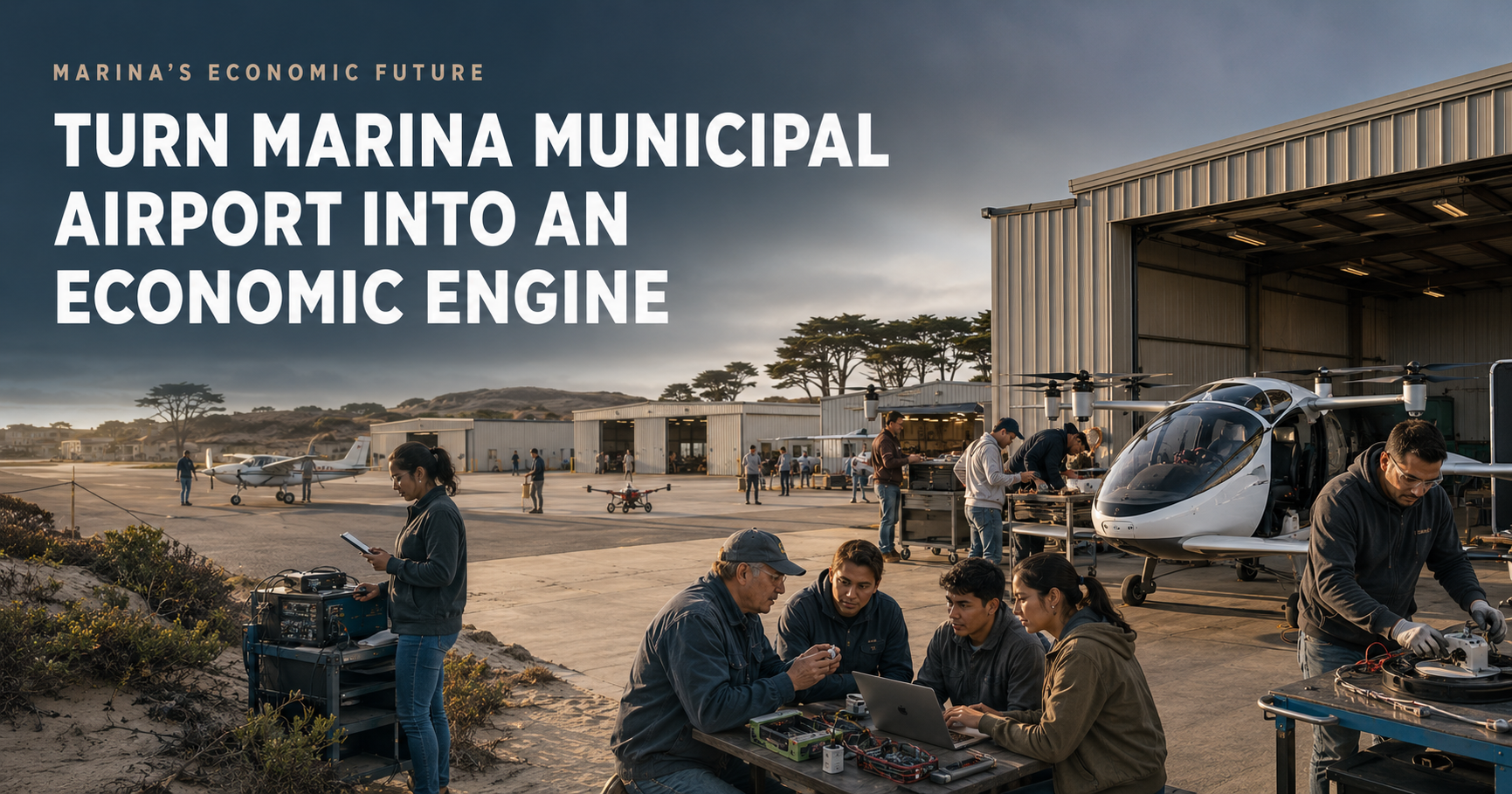
It includes approximately 845 acres and is already dedicated to general aviation, business, light industry and recreation. Joby Aviation has established a major presence there. The Naval Postgraduate School has used airport facilities for research. The airport and surrounding UC MBEST area have supported autonomous-systems, scientific and technology activity.
Build an Industry Cluster Larger Than One Company
The opportunity is larger than one company.
Joby can serve as an anchor for a broader aviation and advanced-technology cluster that includes:
- Aircraft-component suppliers
- Advanced manufacturing
- Composite materials
- Battery diagnostics and energy systems
- Aircraft maintenance and repair
- Flight training and simulation
- Uncrewed aircraft and autonomous systems
- Defense and public-safety technology
- Aviation software and cybersecurity
- Atmospheric and oceanographic research
- Technical education and apprenticeships
Develop a Disciplined Airport Leasing Strategy
Marina should develop a professional inventory of every leasable airport building and parcel, commission current market-rate studies, publish clear leasing opportunities and actively recruit employers that complement existing aviation activity.
Long-term ground leases can preserve public ownership while generating recurring revenue and private investment. Agreements should include construction deadlines, periodic rent adjustments, infrastructure responsibilities and measurable performance requirements so valuable land is not tied up indefinitely.
Understand Where the Financial Benefit Comes From
There is an important limitation. Federal aviation rules generally require airport-derived revenue to remain with the airport system or closely related aviation purposes. Airport rent cannot automatically be transferred to build City Hall or pay unrelated expenses.
The broader benefit comes through the economic activity surrounding the airport: skilled jobs, business-license revenue, employee spending, supplier activity, hotel stays, sales taxes and property or possessory-interest taxes. A financially self-sustaining airport also reduces the risk that other City resources will be needed for airport operations and improvements.
The goal should not be to make the airport a municipal cash machine. It should be to make it the center of a regional industry cluster that expands Marina’s year-round economic base.
Explore Technology That Complements Aviation
Marina should also investigate specialized technology facilities connected to aviation, research and autonomous systems.
A conventional hyperscale data center may not be the best fit. The California Energy Commission projects substantial growth in statewide data-center electricity demand. Large facilities can require extraordinary amounts of electricity, water and backup-generation infrastructure while creating relatively few permanent jobs compared with advanced manufacturing. Aviation-designated land may also be unavailable for unrelated uses.
However, smaller, specialized facilities could complement Marina’s strengths:
- Aviation-data processing
- Flight-simulation computing
- Autonomous-systems research
- Defense and cybersecurity laboratories
- Edge computing
- Digital-twin and aerospace-engineering facilities
- Secure research computing for CSUMB, MBEST or the Naval Postgraduate School
Any proposal should be evaluated against available electrical capacity, fiber connectivity, water use, noise, air quality, permanent job creation and the opportunity cost of the land.
Create a Marina Destination and Tourism Platform
Marina projects approximately $6.49 million in annual transient-occupancy-tax revenue. That is already one of the City’s largest revenue sources.
We can grow it without increasing the tax rate by helping more people discover, visit and stay in Marina.
The municipal website should remain focused on government information and services. Marina also needs an independent destination platform dedicated to promoting:
- Local hotels and restaurants
- Marina State Beach
- Fort Ord trails
- Cycling, hiking and outdoor recreation
- Birding and coastal photography
- Family activities
- Community events
- Aviation education and events
- Regional itineraries that make Marina the home base for exploring Monterey County
This should not be another isolated City marketing project. It should be developed through the Marina Economic Partnership proposed in my recent article, “Making Marina Strong: A Five-Point Community Plan for Economic Growth.” The partnership would bring together the City, Economic Development Commission, Chamber, hotels, restaurants, employers, schools, nonprofits and community organizations.
Success should be measured through hotel occupancy, visitor referrals, event participation, local business engagement and visitor spending.
Connect New Industry to Marina Residents
Economic development should not be measured only by ribbon cuttings, square footage or press releases. It should be measured by whether Marina residents can access the opportunities being created.
An aviation-centered strategy should include:
- Apprenticeship and internship pipelines
- Partnerships with CSUMB, community colleges and local schools
- Aviation maintenance and advanced-manufacturing training
- Veteran recruitment and transition programs
- Quality-control and technical certificate programs
- Local supplier and procurement opportunities
- Clear pathways for young people and career changers
When a local student, veteran, parent or small-business owner can see a realistic path into the new economy, economic development becomes community development.
Dedicate New Growth to Public Facilities
Economic growth does not automatically become a police station, fire station or civic building. Marina should adopt a formal policy connecting new revenue to these needs.
The City could establish a baseline for existing hotel, sales, property and business-license revenue. A defined portion of future revenue above that baseline could then be deposited into a dedicated Public Safety and Civic Facilities Fund.
That fund could combine:
- Incremental revenue from economic growth
- Eligible development-impact fees
- Negotiated developer contributions
- Grants
- Proceeds from appropriate leases or reuse of City property
- Cost savings produced through project redesign and phasing
The City should publish an annual scorecard showing jobs created, employers recruited, leases executed, revenue growth, developer contributions, grants secured and deposits into the facilities fund.
Most importantly, Marina should not issue major debt based solely on projected economic growth. Revenue should demonstrate a stable history before it is pledged to long-term borrowing.
Workforce Housing Is Important, but It Is a Separate Issue
Workforce housing is essential to Marina’s long-term health, but it is a separate policy and financing issue from how the City pays for police, fire, streets and civic facilities. People who teach in our schools, serve our community, work in hospitality, support local businesses or take new aviation and advanced-manufacturing jobs should have a realistic opportunity to live near where they work.
Marina should continue pursuing housing at different income levels, including the City’s Below Market Rate Homeownership Program. But approving more housing does not automatically create enough unrestricted General Fund revenue to finance major municipal buildings, particularly after accounting for the additional services new neighborhoods require.
We should resist using workforce housing as either an argument against economic development or as a substitute for an economic-development strategy. Marina needs both. Housing supports a growing workforce, while skilled jobs, local employers and commercial activity strengthen household incomes and the City’s recurring revenue base.
Each deserves its own serious plan, clear goals and honest accounting.
A Better Community Conversation
I am not arguing that Marina can solve a decades-old facilities problem overnight or that economic growth eliminates every difficult choice.
I am arguing that the choice should not be presented as a permanent 7% utility tax or no solution at all.
Marina can acknowledge the urgent need for safe public facilities while also asking whether we have fully pursued developer responsibility, aviation-led job growth, productive public leasing, tourism, grants, regional partnerships, phased construction and cost reductions.
The question is not whether our police officers, firefighters and City employees deserve better facilities. They do.
The question is whether asking residents to pay more should be Marina’s first and largest strategy, or the last step after a comprehensive economic and financial plan has been presented.
This is an opportunity for the City Council, the new Economic Development Commission, local employers, developers, educators and residents to work together on something larger than a ballot debate.
We can build the facilities Marina needs. We can also build the economic foundation that helps pay for them.
That is the conversation I hope we begin to hear more often prior to November.
Initial Sources
- City of Marina Measure Q information
- City facilities and budget
- Development Impact Fee Nexus Study update
- Marina Municipal Airport
- FAA requirements governing airport revenue
- California Energy Commission data-center information
- Making Marina Strong: A Five-Point Community Plan for Economic Growth
- Marina Should Be Talking About the Future of Flight and the Future of Our Economy

Geno Quiroz serves on the Marketing & Technology team at IPX1031, a Fidelity National Financial company and a national leader in 1031 tax-deferred exchange services. In his current role, Geno focuses on website architecture, design, development, SEO/AIO, and digital marketing strategy. His work helps strengthen the company’s digital presence, improve user experience, and ensure that IPX1031’s online platforms effectively support client engagement and long-term growth.
Concurrently, Geno continues to lead Monterey Premier, the web design and strategic consulting firm he founded in 2015. Through Monterey Premier, he partners with entrepreneurs, nonprofits, and growing organizations to design high-performance websites, refine digital sales funnels, and implement conversion-focused strategies.
His hands-on experience building and scaling a client-facing agency has provided him with a real-world understanding of growth strategy, brand positioning, and the operational realities of business ownership — experience that now directly informs and strengthens his work in enterprise marketing technology.