
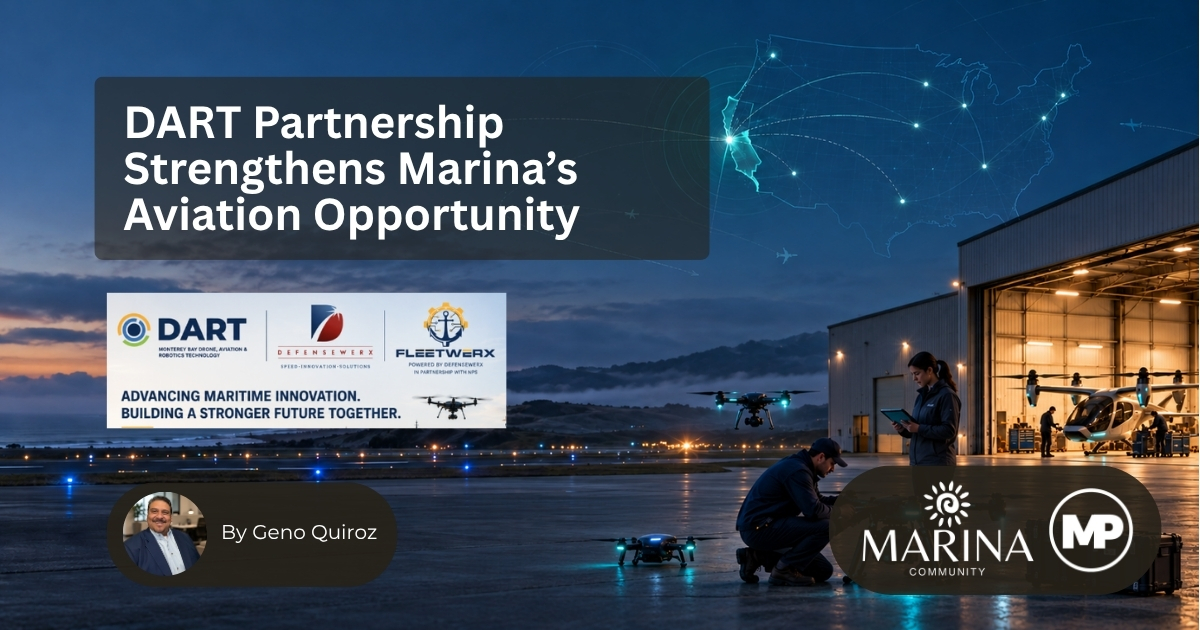
A new partnership connecting the Monterey Bay region with a national defense innovation network offers more evidence that advanced aviation is becoming a real economic opportunity. The question is whether Marina will intentionally participate in it.
In my recent articles, I have written about the advanced-aviation industry developing around Marina and Monterey County.
- Joby Is Flying the Future. Will Marina Help Build It?
- Shaping the Future of Fort Ord and Marina’s Opportunity to Be Part of It
- Marina Measure Q: Before New Taxes, Let’s Build a Stronger Economy
- A Five-Point Community Plan for Marina’s Economic Growth
- Marina Should Be Talking About the Future of Flight and the Future of Our Economy
Joby Aviation is manufacturing and testing electric aircraft at Marina Municipal Airport. Archer Aviation is conducting flight testing in Salinas. Monterey Regional Airport, our regional colleges, the Naval Postgraduate School, and several workforce organizations are also becoming part of this growing network.
I covered those regional assets in “Marina Should Be Talking About the Future of Flight and the Future of Our Economy.”
Now another piece has been added.
Connecting the Central Coast to a National Network
Monterey Bay Drone, Aviation, and Robotics Technology, better known as DART, recently signed an agreement with DEFENSEWERX.
DEFENSEWERX is a national nonprofit that connects businesses, researchers, universities, and technology developers with the United States military and other federal agencies.
Locally, the partnership will work through FLEETWERX, an innovation hub connected with the Naval Postgraduate School.
According to DART’s announcement, the organizations will share information, develop programs, and help Central Coast businesses and workforce participants connect with defense innovation opportunities across the country.
An agreement like this does not guarantee that new contracts, jobs, or facilities will come to Marina. However, it creates another connection between our region and a much larger national industry.
That matters.
This Is About More Than Air Taxis
When people hear “eVTOL,” they usually imagine passenger air taxis flying over traffic.
That may eventually become part of the industry, but it is not necessarily Marina’s greatest opportunity.
As I explained in “Joby Is Flying the Future. Will Marina Help Build It?”, Marina may be better positioned to support what happens behind the flights:
- Manufacturing and aircraft assembly
- Testing and maintenance
- Robotics and autonomous systems
- Software and cybersecurity
- Battery and electrical technology
- Workforce training
- Research and defense applications
Many of these technologies can serve both civilian and military purposes. A drone, sensor, autonomous system, or communications platform might be used for agriculture, wildfire response, infrastructure inspections, emergency services, maritime operations, or national defense.
The DART and DEFENSEWERX partnership expands the conversation from passenger aircraft to the much larger technology economy developing around them.
The Regional Network Is Becoming Clearer
We now have Joby in Marina, Archer in Salinas, the Naval Postgraduate School in Monterey, regional airports, colleges, workforce programs, DART, FLEETWERX, and access to the DEFENSEWERX national network.
These are not all part of one company or government program. They are separate organizations beginning to connect around aviation, drones, robotics, manufacturing, research, and workforce development.
That is how an industry cluster begins.
Marina does not need to become another Dallas-Fort Worth. We do not have its population, major airports, corporate headquarters, or enormous transportation market.
What we have is different.
We have an airport where advanced aircraft are already being manufactured and tested. We have neighboring institutions with national research and defense connections. We have land that was intended to support aviation, research, and job creation.
We are not starting from zero.
Marina Was Not Supposed to Become Only a Bedroom Community
After I published my recent articles, a longtime Marina resident sent me an encouraging message.
The resident reminded me that after Fort Ord closed, Marina’s vision was not simply to build more housing. The City’s 2000 General Plan called for a better balance between jobs and housing so more residents could live and work in the same community.
Instead, Marina gradually became more of a bedroom community, with many residents commuting elsewhere for work. Now, as pressure grows to build even more housing, including much-needed affordable housing, we need to be careful that we do not make that imbalance worse.
This is not an argument against affordable housing. Working families, young adults, seniors, teachers, first responders, and service employees all need homes they can afford. But affordability cannot be solved only by increasing the number of housing units while overlooking the jobs, wages, infrastructure, and public services needed to support a growing population.
If Marina continues adding housing without creating a stronger employment base, more residents may be forced to commute outside the city for work. At the same time, the cost of providing police, fire protection, roads, parks, and other services will continue to rise.
Housing growth without economic growth could push Marina even further toward becoming the bedroom community its General Plan said it should not become.
A complete community needs housing at a range of prices, but it also needs employers, skilled careers, local businesses, and reliable sources of public revenue. We should be planning for both at the same time.
The resident’s message encouraged me because it showed that others recognize the imbalance and understand that Marina still has an opportunity to correct it before more of our employment land and economic potential are lost.
Protect the Land That Can Create Jobs
The Marina Municipal Airport and the neighboring UC MBEST property were intended to contribute to Marina’s economic recovery after the closure of Fort Ord.
In 2020, the City approved the Marina Municipal Airport Business and Industrial Park/UC MBEST Center Specific Plan. It was designed to support aviation, research, manufacturing, business development, and employment.
That does not mean environmental concerns should be ignored or that every development proposal should be approved.
It means we should understand which properties are best suited for housing and which are uniquely valuable for employment.
We can build housing in appropriate locations, protect sensitive habitat, and preserve airport-compatible land for the industries that need it.
Once specialized airport and employment land is converted to an incompatible use, we may never get that opportunity back.
Proximity Is Not a Strategy
Marina will not automatically benefit simply because Joby operates here or because regional partnerships are being formed nearby.
Jobs located in Marina may be filled by people who live elsewhere. Companies may hire contractors from outside the region. Visiting professionals may stay and spend their money in other cities.
If Marina wants its residents and businesses to benefit, the City must participate intentionally.
That means communicating with Joby, DART, FLEETWERX, NPS, our colleges, and other regional partners. It means understanding what infrastructure employers need, helping residents find training and apprenticeships, and preparing local businesses to compete for contracts.
In “Making Marina Strong: A Five-Point Community Plan for Economic Growth,” I proposed bringing the City, Chamber of Commerce, Marina Foundation, educators, employers, service organizations, and community leaders together around a shared economic mission.
This is exactly the kind of opportunity that requires that cooperation.
Marina does not need to create another large government program or duplicate the work DART is already doing. We need to make sure Marina has a seat at the table and a clear plan for connecting our residents and businesses with the opportunities being developed.
An Opportunity to Course-Correct
For nearly 30 years, Marina has struggled to replace the economic foundation lost when Fort Ord closed.
We have added homes and welcomed new residents, but our employment base has not grown at the same pace.
Advanced aviation will not solve every economic challenge facing Marina. Joby should be one part of a diverse economy, not the entire strategy. New technologies and companies always involve risk.
But something real is developing around us.
The Central Coast is building connections among aviation companies, airports, researchers, colleges, workforce programs, defense organizations, and national innovation networks.
Marina already holds an important place in that network.
The question is whether we will simply host some of this activity or whether we will use it to create careers, strengthen local businesses, grow City revenue, and build a more complete community.
The regional pipeline is forming. Now Marina must decide how it intends to connect to it.

Geno Quiroz serves on the Marketing & Technology team at IPX1031, a Fidelity National Financial company and a national leader in 1031 tax-deferred exchange services. In his current role, Geno focuses on website architecture, design, development, SEO/AIO, and digital marketing strategy. His work helps strengthen the company’s digital presence, improve user experience, and ensure that IPX1031’s online platforms effectively support client engagement and long-term growth.
Concurrently, Geno continues to lead Monterey Premier, the web design and strategic consulting firm he founded in 2015. Through Monterey Premier, he partners with entrepreneurs, nonprofits, and growing organizations to design high-performance websites, refine digital sales funnels, and implement conversion-focused strategies.
His hands-on experience building and scaling a client-facing agency has provided him with a real-world understanding of growth strategy, brand positioning, and the operational realities of business ownership — experience that now directly informs and strengthens his work in enterprise marketing technology.