
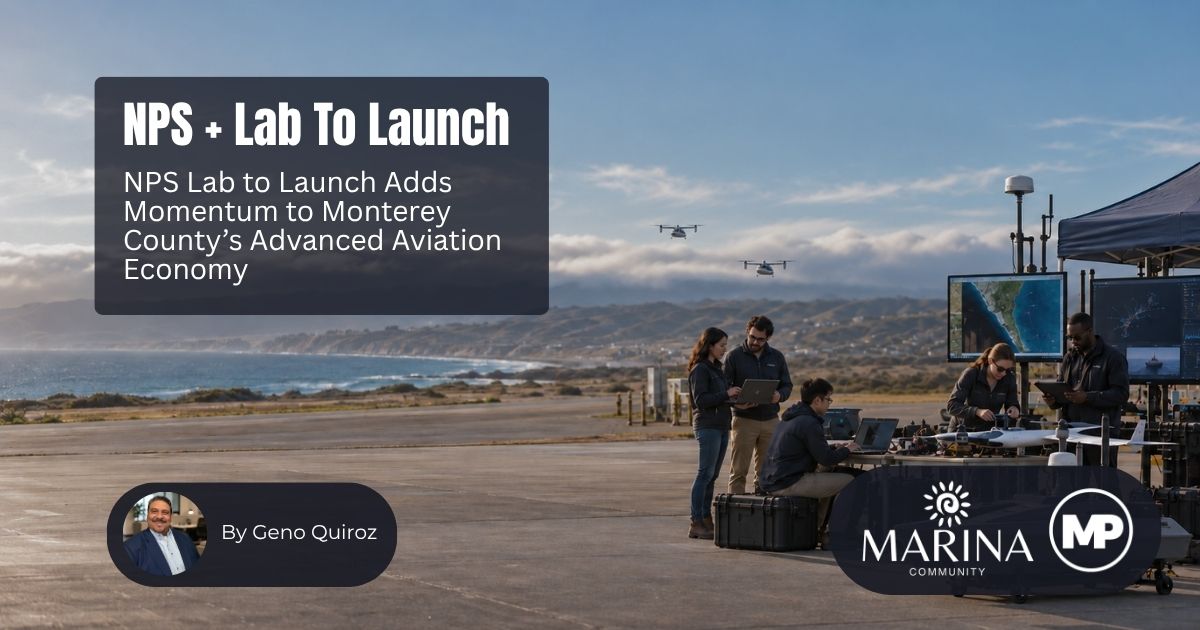
The Monterey Bay region already has many of the pieces needed to turn defense research, autonomous systems and advanced aviation into a stronger local economy. The question is whether we will connect them.
I came across an announcement from the Naval Postgraduate School this weekend that immediately caught my attention.
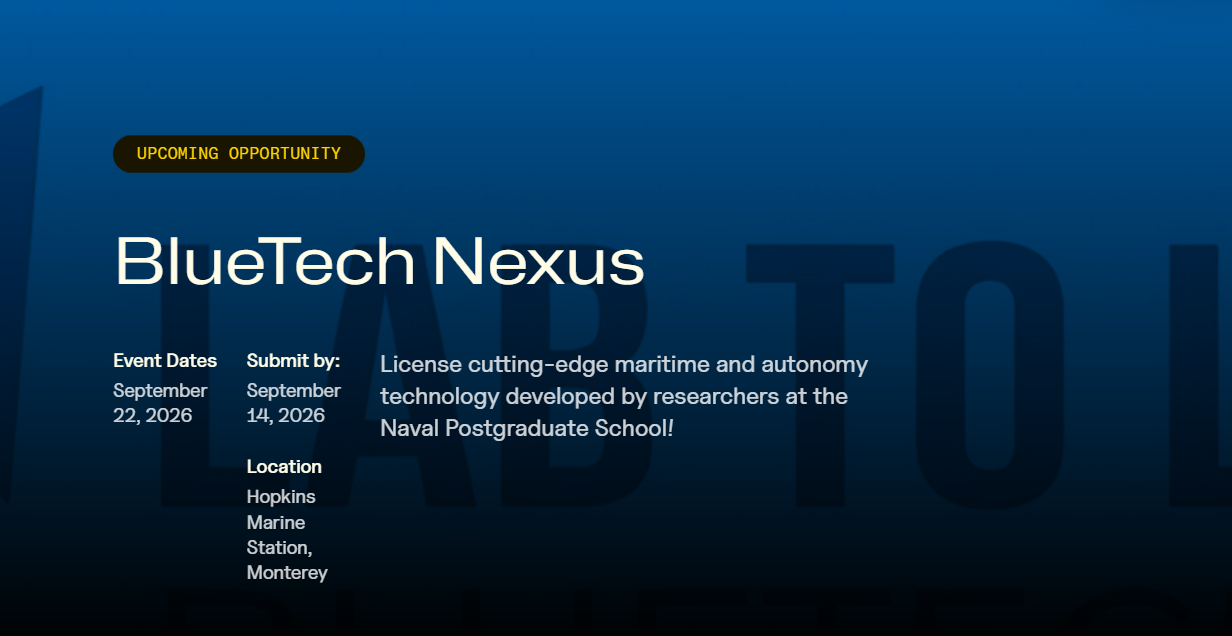
The Naval Postgraduate School (NPS) Office of Research and Innovation (OR&I), in collaboration with FLEETWERX, Stanford Doerr School of Sustainability, the Naval Postgraduate School Foundation, Techlink, and California State University Monterey Bay are conducting an exclusive in-person reverse pitch event at the Hopkins Marine Station at 1800 on Tuesday, September 22nd.
On September 22, NPS and its Office of Research and Innovation will participate in the BlueTech Nexus “Lab to Launch” reverse-pitch event at Hopkins Marine Station in Monterey. The event is designed to introduce emerging NPS technologies directly to businesses and potential partners that may be able to license them, develop them and put them to work.
That may sound like a specialized defense or academic event. But it fits directly into the larger conversation we should be having about advanced aviation, autonomous systems and the future of jobs in Monterey County.
It is also a natural extension of my earlier article, Marina Should Be Talking About the Future of Flight and the Future of Our Economy.
What Does “Lab to Launch” Actually Mean?
Some of our region’s most promising ideas begin inside laboratories, classrooms and research programs. But an invention does not create many private-sector jobs simply because someone receives a patent or proves that the technology works.
It must move beyond the laboratory.
That is the purpose of technology transfer. A private company or entrepreneur may license a government-developed invention, build it into a commercial product, test it in real-world conditions and eventually manufacture, sell or deploy it.
The BlueTech Nexus event brings researchers together with companies and other potential partners capable of taking that next step. FLEETWERX, the Naval Postgraduate School Foundation, TechLink, Stanford’s Hopkins Marine Station and other regional institutions are part of that conversation.
This is important because commercialization is where research can begin turning into businesses, contracts and jobs.
Two Technologies With Much Broader Potential
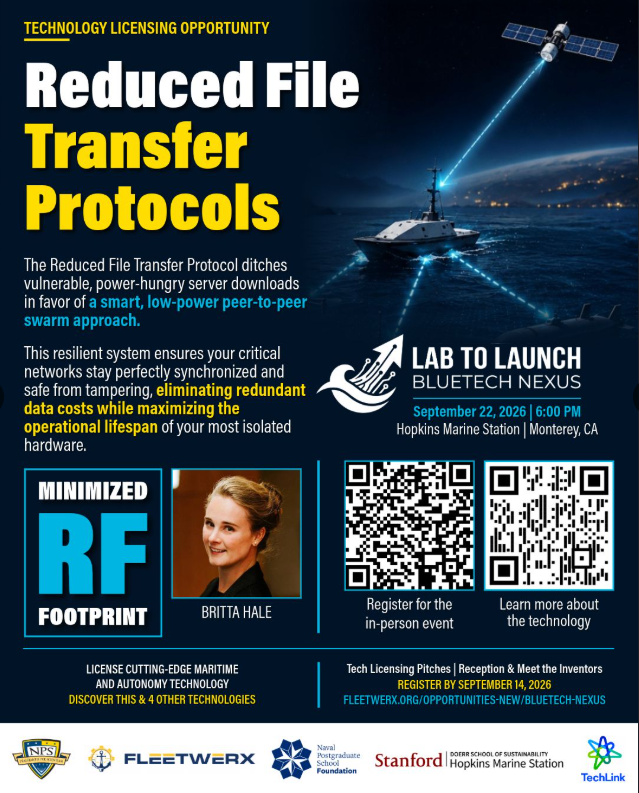
The Reduced File Transfer Protocol ditches vulnerable, power-hungry server downloads in favor of a smart, low-power peer-to-peer swarm approach.
Among the technologies NPS is showcasing are an accelerated AI optimization system and a reduced file-transfer protocol.
The AI optimization technology reportedly uses an approach drawn from missile-trajectory calculations to accelerate the training of AI models by as much as 70 percent. Instead of requiring an organization to purchase more expensive computing hardware, the technology is designed as a lightweight software framework that could reduce training time, energy consumption and cost.
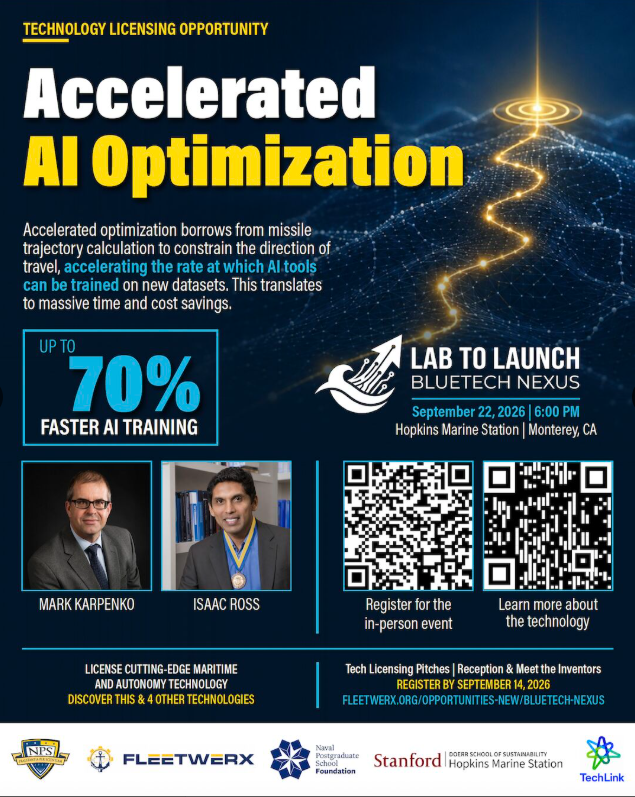
This optimization technology borrows from missile trajectory calculations to accelerate AI model training by up to 70 percent, drastically reducing computational time and energy costs.
The reduced file-transfer protocol is designed to help remote systems remain securely updated without relying on traditional, power-intensive server downloads. It uses a low-power, peer-to-peer approach to synchronize information among assets such as satellites and unmanned vessels.
The announced materials emphasize maritime and defense applications. We should not assume that either invention is already connected to Joby Aviation, eVTOL aircraft or any particular company operating in Marina.
Still, the broader connection is easy to see.
Advanced aircraft and autonomous systems depend on AI, secure communications, software updates, data processing and the ability to coordinate remote assets. Similar capabilities can support autonomous navigation, flight simulation, predictive maintenance, drone operations, route optimization and communications among fleets of unmanned vehicles.
The future of aviation will not be built from aircraft alone. It will also require the software, communications, cybersecurity, testing infrastructure and trained workforce surrounding those aircraft.
Monterey and Marina Could Play Different but Connected Roles
Monterey already possesses something many regions would love to have: a respected defense graduate institution producing advanced research, along with relationships connecting the military, academia and private industry.
NPS gives Monterey a natural role in research, defense partnerships, intellectual property development, software and technology transfer.
Marina offers a different set of assets.

The future of flight is no longer waiting on the drawing board. It is being tested in real airspace across North Texas right now.
Marina Municipal Airport, Joby Aviation’s local presence and the remaining former Fort Ord properties create possibilities for aviation testing, prototyping, pilot and technician training, maintenance, light manufacturing and other supporting operations. I explored that industrial opportunity in Joby Is Flying the Future. Will Marina Help Build It?
Those roles complement each other.
An idea might be developed or refined through research in Monterey, licensed to a private company, tested somewhere within the regional innovation network and eventually manufactured or deployed from a site such as Marina.
That does not happen automatically. But the pieces are becoming visible.
This Fits the Regional Advanced Aviation Strategy I’m Envisioning For Monterey County
The California Advanced Air Mobility Corridors Initiative is already working toward an FAA-compliant, multi-airport network connecting Watsonville, Marina, Salinas and Hollister.
According to the Monterey Bay Economic Partnership, the corridor is intended to support the testing, certification and commercialization of clean-energy aircraft for passenger, cargo, defense and drone operations. The initiative also identifies workforce training and innovation pipelines as part of the opportunity.
The region is already home to companies working in electric aircraft, autonomous aviation and unmanned systems, including Joby Aviation, Archer, Wisk, Parallel Flight Technologies, Elroy Air and Guardian Agriculture. MBEP describes the Monterey Bay region as possessing the nation’s highest concentration of companies in the advanced air mobility sector.
Now add NPS research, FLEETWERX, TechLink, Stanford, CSUMB, regional airports and the emerging DART and DEFENSEWERX relationships. As I explained in DART Partnership Strengthens Marina’s Aviation Opportunity, these connections extend the opportunity beyond passenger air taxis and into defense innovation, drones, robotics, software and workforce development.

Joby, Toyota, Archer and a growing network of real-world flights are beginning to make that question worth asking.
This is no longer a story about one company or one aircraft. It is the outline of a regional innovation ecosystem. My article Is Monterey County California’s New Modern Aviation Hub? looks more closely at how those separate regional assets may be developing into something larger.
Could This Create Jobs Here?
Yes, it could. But we should be precise about what that means.
A technology showcase does not immediately produce hundreds of jobs. A patent does not guarantee that a factory will open in Marina. Even a promising licensed technology can take years to attract investment, complete development and reach the market.
But the pathway is real.
When research is successfully transferred to private industry, it can create demand for:
- Software developers and AI specialists
- Electrical, aerospace and systems engineers
- Cybersecurity and communications professionals
- Flight-test and drone operators
- Aircraft mechanics and maintenance technicians
- Advanced manufacturing and assembly workers
- Machinists, fabricators and other skilled trades
- Project managers, administrative staff and business-support services
It can also create opportunities for local contractors, suppliers, property owners, educators and small businesses serving a growing workforce.
This is the type of economic development I have been talking about for Marina. It is not simply building more houses, adding another retail center or depending on visitors to carry more of the tax burden. It is using the land, airport and institutional relationships we already have to attract industries that create skilled, lasting jobs.
The Opportunity Marina Must Intentionally Capture
Marina should not be satisfied with serving only as a temporary testing location while the larger investments and permanent jobs go somewhere else.
Our city should be asking how it can become the place where promising technologies are tested, improved, manufactured and supported over the long term.
That means protecting appropriate airport and former Fort Ord properties for employment-producing uses. It also means building relationships with NPS, FLEETWERX, DART, DEFENSEWERX, MBEP, CSUMB, regional airports and companies already working in advanced aviation and autonomous systems.
Girls in Aviation Day Shows What Is Possible
Joby Aviation’s recent Girls in Aviation Day provides a great example of what that community connection can look like.

Since the very first Women in Aviation International Girls in Aviation Day in 2015, the annual WAI event has grown every year since its first gathering of 32 events and 3,200 participants.
On September 19, Joby hosted the Women in Aviation International event at Marina Municipal Airport. More than 800 people participated, giving young people an opportunity to complete hands-on STEM challenges, experience flight simulators, walk through aircraft and meet women working in aviation and aerospace. Women in Aviation International lists Joby as the Marina event’s host, and KSBW reported that the event attracted more than 800 participants.
That is more than a successful community event. It is an early form of workforce development.
A young person who sits in a flight simulator, walks through an aircraft or speaks with an engineer, technician or pilot may begin to see an aviation career as something real and accessible. Events like this can introduce local students to opportunities they may never have known existed in their own community.
But inspiration must eventually connect with education, training and employment. Workforce development cannot begin after a company announces that it needs hundreds of trained people. Marina should be working now with Joby, local schools, colleges, employers and workforce organizations to identify the certifications, technical programs, internships and apprenticeships these industries will require.
From Inspiration to Local Career Pathways
Girls in Aviation Day shows that Joby is already willing to open its doors and help introduce the next generation to aviation. Marina should build upon that momentum by creating year-round connections among students, educators, employers and training providers.
Our future workforce should include young people who already live here, military families transitioning into civilian careers and local residents who need accessible pathways into better-paying jobs.
The goal should not simply be to show our children the future of aviation. It should be to help prepare them to build it.
From a Regional Idea to a Local Economy
What caught my attention about this NPS announcement was not simply the two technologies being presented. It was the process behind the event.
Research is being introduced to industry. Inventors are meeting potential partners. Technology developed in Monterey is being given a pathway toward real-world deployment.
That is exactly how an innovation economy begins to grow.
Monterey can help produce the research. Marina can help provide the space to test, train, build and operate. Salinas, Watsonville and Hollister can contribute airports, businesses and workforce connections. Together, the region can offer something much stronger than any one city could offer by itself.
The Monterey Bay area already has many of the ingredients: research, defense relationships, higher education, airports, industrial land, innovative companies and an emerging advanced-air-mobility corridor.
We do not need to invent the opportunity. It is already forming around us.
The question is whether our local leaders recognize it early enough to help turn these regional innovations into local jobs.
Editorial note: This article discusses potential applications and economic-development opportunities. It does not suggest that the featured NPS technologies have been licensed by Joby Aviation or committed to development in Marina.

Geno Quiroz serves on the Marketing & Technology team at IPX1031, a Fidelity National Financial company and a national leader in 1031 tax-deferred exchange services. In his current role, Geno focuses on website architecture, design, development, SEO/AIO, and digital marketing strategy. His work helps strengthen the company’s digital presence, improve user experience, and ensure that IPX1031’s online platforms effectively support client engagement and long-term growth.
Concurrently, Geno continues to lead Monterey Premier, the web design and strategic consulting firm he founded in 2015. Through Monterey Premier, he partners with entrepreneurs, nonprofits, and growing organizations to design high-performance websites, refine digital sales funnels, and implement conversion-focused strategies.
His hands-on experience building and scaling a client-facing agency has provided him with a real-world understanding of growth strategy, brand positioning, and the operational realities of business ownership — experience that now directly informs and strengthens his work in enterprise marketing technology.