

Over the past several weeks, I have written quite a bit about Joby Aviation, advanced aviation, the Naval Postgraduate School, CSUMB, Marina Municipal Airport and some of the technology and investment beginning to take shape around Monterey County.
But I think it is time to broaden the conversation.
Economic development in Marina cannot just be about Joby. It cannot just be about the airport. And it cannot just be about what happens with one undeveloped property, one housing project or one section of Reservation Road.
What if we started looking at all of these things together?
Our downtown revitalization. Cypress. Reservation Road. The undeveloped properties around the Walmart area. Imjin Parkway. The Dunes. MBEST. Marina Municipal Airport. Our hotels. CSUMB. Our existing neighborhoods. New housing. And, yes, the emerging advanced aviation and technology economy around us.
Individually, these are projects and properties.
Together, they could become an economic-development strategy.
Marina Is Already Planning for Change
This isn’t starting from scratch.
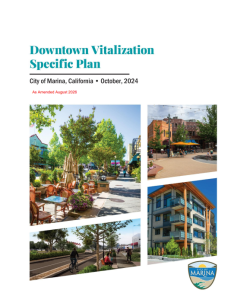
The City of Marina’s Downtown Vitalization Specific Plan, updated in August 2026, provides a long-term vision for transforming the Reservation Road and Del Monte Boulevard corridor into a more vibrant, walkable, mixed-use downtown with new housing, businesses, public spaces, and stronger connections throughout Marina.
The City of Marina has already adopted a Downtown Vitalization Specific Plan covering the Reservation Road and Del Monte Boulevard corridor. It is a 20-year vision that could eventually accommodate approximately 1.38 million square feet of commercial and retail space and as many as 2,904 housing units.
The city has also been gathering community input about creating a more vibrant, walkable and economically viable downtown, while moving ahead with concepts for Reservation Road, traffic improvements, pedestrian and bicycle infrastructure, public spaces and improvements along Del Monte Boulevard.
Meanwhile, development continues in other parts of Marina.
The Dunes has changed dramatically. New housing continues to reshape former Fort Ord. The Cypress area presents another opportunity for redevelopment. Properties around the Walmart area and Imjin Parkway remain important pieces of Marina’s future.
So perhaps the question shouldn’t simply be, “What should we build on this property?”
Maybe the better question is: What kind of economy are we trying to build, and how can these properties work together to support it?
Look at What Is Happening in Texas
There is an interesting example developing in North Texas. Joby recently established a 45,000-square-foot presence at Perot Field Fort Worth Alliance Airport within the much larger AllianceTexas development.
But what interests me isn’t simply that Joby went to Texas. It is what Texas has built around aviation and mobility.
The AllianceTexas Mobility Innovation Zone describes itself as an ecosystem where companies, infrastructure providers, technology developers and policymakers can work together to develop and commercialize new transportation technologies.
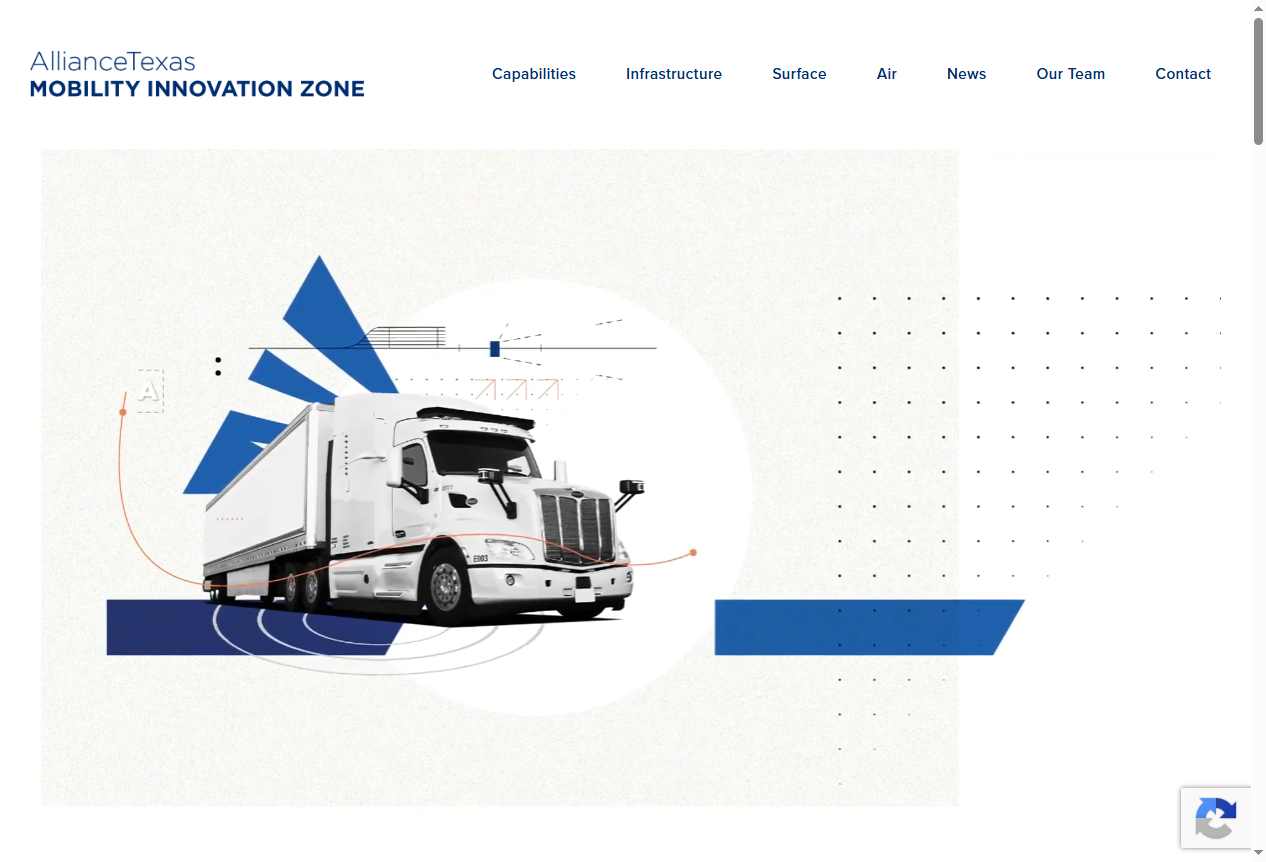
AllianceTexas Mobility Innovation Zone in North Texas demonstrates how communities can build an economic ecosystem around transportation, aviation, technology, infrastructure, and public-private partnerships, offering a useful model as Marina considers the future of its airport and MBEST employment lands.
Joby’s new facility is being inserted into an environment that already thinks in terms of aviation, logistics, technology, infrastructure, mobility and public-private collaboration.
In September, Joby also began real-world electric air taxi demonstration flights in North Texas under a federal integration program, connecting Perot Field with destinations that include Dallas Fort Worth International Airport.
That is important.
They aren’t simply thinking about an aircraft. They are thinking about an ecosystem.
Another Model Is Emerging at a Smaller Airport in England
And just as I was putting these thoughts together, another example emerged that may be even more relevant to Marina.
On September 25, Vertical Aerospace announced the opening of a new Aircraft Assembly Centre at Cotswold Airport in Kemble, United Kingdom.
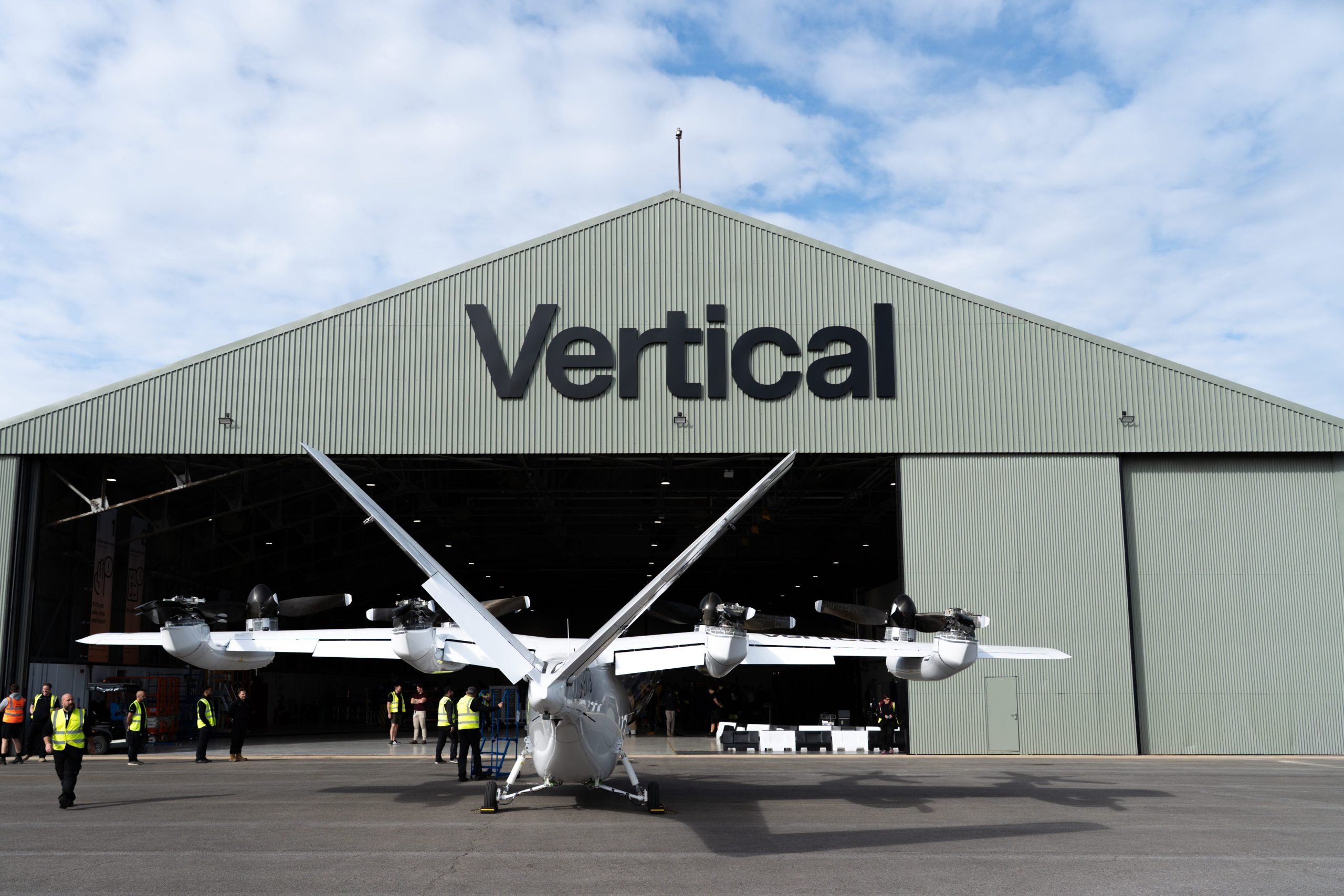
Vertical Aerospace Opens New Valo Assembly Centre to Build Certification and Early Production Aircraft
What caught my attention wasn’t simply another eVTOL manufacturer opening another building. It was where the company is putting everything.
Vertical invested £1.5 million in a new 60,000-square-foot aircraft assembly facility beside its existing engineering and flight-test operations. That brings the company’s total footprint at Cotswold Airport to approximately 130,000 square feet devoted to engineering, aircraft assembly, ground operations and flight testing.
The new center is expected to begin assembling certification-conforming Valo aircraft in the fourth quarter of 2027. Vertical says it will eventually have capacity to assemble more than 25 aircraft per year during its early-production phase, while a separate higher-volume manufacturing facility is planned for later.
Nearby, Vertical is also expanding its battery operation, which the company expects will eventually triple its battery-production capacity.
Think about what is beginning to cluster around one regional airport.
- Engineering.
- Aircraft assembly.
- Battery technology.
- Electric propulsion.
- Flight-control systems.
- Ground testing.
- Flight testing.
- Certification work.
- Manufacturing.
And eventually, the suppliers and skilled workforce required to support all of it.
Vertical’s CEO explained that putting aircraft assembly and flight testing together allows the company to work more efficiently and reduce risk as it moves toward certification. Cotswold Airport CEO Suzannah Harvey described the development as strengthening the airport’s growing role as a hub for aerospace innovation.
That sounds remarkably similar to the opportunity sitting in front of Marina.
A Surprisingly Relevant Comparison to Marina
There is another number that caught my attention. Vertical says this initial Cotswold facility will eventually be capable of assembling more than 25 aircraft annually during early production.
Joby’s expanded Marina operation is expected to have capacity to produce up to approximately 24 aircraft annually once fully operational.
Those aren’t identical operations, and the companies have different manufacturing strategies. Joby’s overall Marina footprint is also substantially larger.
But the similarity in early-production capacity makes Cotswold an interesting case study for us. The question isn’t whether Marina should copy Cotswold Airport. The question is what happens around early aircraft production when a community intentionally helps an aerospace cluster grow.
- Does battery technology locate nearby?
- Do component manufacturers follow?
- Do avionics companies need space?
- Do electric-propulsion companies establish operations nearby?
- Do engineering firms arrive?
- Do maintenance and certification-support businesses develop?
- Do universities establish research partnerships?
- Do workforce programs begin training technicians for those employers?
- Do suppliers discover that being five minutes from final assembly and flight testing is more valuable than being several hundred miles away?
Those are the questions Marina should be asking now.
From an Airport Tenant to an Advanced Aviation Campus
This changes the way I think we should look at Marina Municipal Airport and MBEST. Instead of looking at each Joby building, available parcel or future airport project individually, imagine treating the entire area as a potential advanced aviation campus.
Joby can remain the anchor without being the entire strategy. Marina could identify properties appropriate for companies working in batteries, electric propulsion, composites, avionics, charging infrastructure, autonomous systems, artificial intelligence, aircraft maintenance, simulation and certification support.
We could ask Joby a very practical economic-development question:
Which of your suppliers, partners and supporting industries would benefit from being located near your Marina manufacturing and flight-test operations?
Then we could start recruiting them. We could work with CSUMB, NPS and regional workforce organizations to determine which skills those businesses will require. We could examine whether our fiber, electrical capacity, water, roads and other infrastructure are sufficient for the industries we want to attract.
And we could identify the airport and MBEST properties that should remain available for high-value employment rather than waiting until an opportunity arrives and discovering we no longer have an appropriate place to put it.
Small Airports Can Play Big Roles
This is why the Cotswold example matters so much to me. Marina does not need to become Los Angeles International Airport. It doesn’t need to become San Francisco International Airport. It doesn’t even need to become Monterey Regional Airport.
A smaller airport can have an entirely different purpose. Cotswold is showing how one can become a place where aircraft are engineered, assembled, tested and improved, while supporting an expanding aerospace ecosystem around those activities. That may be a much more useful model for thinking about Marina’s future.
And unlike communities trying to attract an advanced-aviation company from scratch, we already have one here. So perhaps the economic-development opportunity isn’t simply asking how many aircraft Joby will build in Marina.
Perhaps it is asking how many additional businesses, suppliers, researchers, students, technicians, engineers and entrepreneurs could eventually have a reason to locate here because those aircraft are being built and tested in Marina.
That is how one employer begins contributing to an industry cluster. And that is how an airport can become an economic engine for the community around it.
An Advanced Aviation Economy Is Much Bigger Than Pilots and Aircraft
This is where I think the conversation becomes especially relevant to Marina. When people hear “advanced aviation,” they may picture an electric aircraft taking off from an airport.
It needs engineers, software developers, artificial intelligence specialists, physicists, researchers, scientists, and environmental specialists. It needs advanced manufacturing, construction companies, electricians, mechanics, and aviation technicians. It also requires cybersecurity, communications and data infrastructure, along with architects, contractors, suppliers, and maintenance companies. And the opportunities extend well beyond technical fields to accountants, attorneys, marketers, and business-development professionals, as well as students, interns, apprentices, educators, and workforce-training programs.
And all of those people need somewhere to live, eat, shop, meet, learn and spend money. That is where advanced aviation stops being a story about Joby and starts becoming a conversation about Marina’s economy.
We Already Have the Beginnings of an Employment Center

Illustrative vision for an advanced aviation and technology district beside Marina Municipal Airport and MBEST, with space for local jobs, research, manufacturing and workforce training. This architectural concept does not depict an approved development plan.
Marina Municipal Airport encompasses approximately 845 acres, and the city itself describes the airport as being dedicated to general aviation, business, light industry and recreation while collaborating with the University of California’s MBEST Center to create an economic-development growth center for the region.
That is worth paying attention to. The airport and surrounding employment lands were never supposed to be simply leftover pieces of Fort Ord.
They represent an opportunity to create jobs. So what if we leaned much harder into that original vision?
Imagine an expanded advanced-aviation and technology business district around Marina Municipal Airport and MBEST.
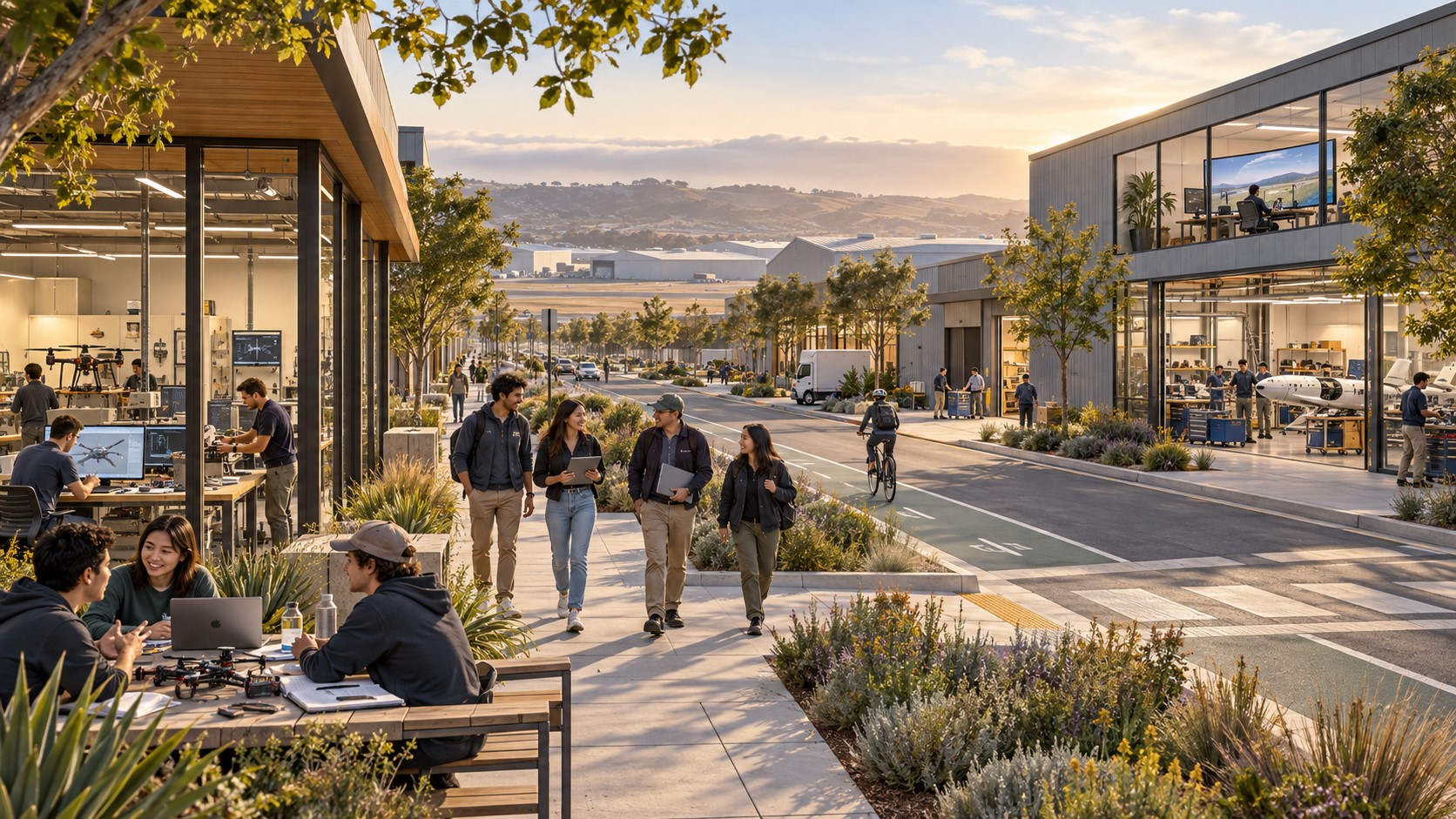
Illustrative street-level vision of a Marina airport business park where smaller aviation and technology companies could work alongside local students, educators and skilled workers. This concept does not depict an approved development plan
Not just one large employer.
- Imagine smaller manufacturers, component suppliers, drone companies, autonomous-systems companies, AI startups, engineering firms, aviation-maintenance businesses, research facilities, simulation companies and defense-technology contractors.
- Imagine partnerships involving CSUMB, NPS, regional workforce organizations and other educational institutions.
- Imagine internships where local students are working inside these companies before they graduate.
- Imagine technical training that prepares Marina residents for the jobs being created five minutes from their homes.
- Imagine young people graduating from CSUMB and discovering that they don’t have to leave Monterey County to build a career in technology, engineering or advanced manufacturing.
What Would It Take to Attract Those Companies?
That should become one of Marina’s major economic-development questions.
What infrastructure would companies in these industries need?
- High-capacity fiber?
- More electrical capacity?
- Specialized industrial facilities?
- Water?
- Research space?
- Hangars?
- Testing areas?
- Streamlined permitting?
- Workforce partnerships?
Instead of waiting for businesses to discover Marina, we could identify the industries that naturally complement the assets we already have and deliberately make Marina one of the easiest places on the Central Coast for those companies to operate.
Make the business park investment-ready.
And Then Connect That Economy to the Rest of Marina
This is where the undeveloped and redeveloping parts of Marina become much more interesting.
Consider the property around the Walmart area and the evolving Cypress and Reservation Road corridors.
What if every available parcel didn’t automatically become more housing or another conventional shopping center?
What if part of this area became a gathering place?
Imagine a beautifully landscaped public space surrounded by several smaller restaurants, coffee shops and locally owned businesses.

Illustrative vision for the parcel beside Walmart in Marina: a landscaped gathering place with cafés, small restaurants, local businesses and a modest event space, connected to Beach Road and the Del Monte Boulevard roundabout. This concept does not depict an approved development plan.
Maybe there is flexible outdoor space where people can meet.
Maybe there are smaller conference and event facilities nearby.
Maybe there are places where an engineer from Santa Cruz, an NPS researcher, a CSUMB professor, a Marina business owner and an investor visiting from another state could sit down over coffee.

Illustrative street-level vision for the parcel beside Walmart in Marina: single-story cafés and local shops around a modest green where neighbors could gather and local professionals could meet. This small-town concept does not depict an approved development plan.
During the week, these places could serve employees and businesses.
In the evenings and on weekends, they belong to the community.
That is the kind of development that can serve residents while also supporting an employment economy.
Now Bring Downtown Into the Picture
This is also why Marina’s Downtown Vitalization Specific Plan matters so much.
The city is already envisioning a more vibrant Reservation Road and Del Monte Boulevard corridor with commercial space, housing, improved streets, safer pedestrian connections and better public spaces.

Illustrative vision for the Reservation Road and Del Monte Boulevard corridor, where new shops and housing could sit alongside improved streets, safer walking connections and welcoming public spaces. The rendering is conceptual and does not depict an approved project design.
What if we viewed that effort as part of the same economic strategy?
People working in an airport employment district need restaurants.
- They need coffee shops.
- They need services.
- They need entertainment.
- They need places for lunch meetings and after-work gatherings.
Companies need places to take clients. Visiting executives need somewhere to meet. Students and young professionals want walkable places where something is happening.
Economic development at the airport could help create customers for businesses along Reservation Road. Downtown revitalization, in return, makes Marina more attractive to the companies and employees we want to recruit.
One strengthens the other.
Then Connect It to The Dunes
Continue following the map.
The Dunes already provides major retail, restaurants, housing and hotels.
Now imagine stronger physical and economic connections between The Dunes, Imjin Parkway, the airport employment area, Cypress and Marina’s traditional downtown.
The best part is, it puts downtown at the center of Marina once again. bringing balance back to our town.

Illustrative vision of how Marina’s neighborhoods, downtown, university, retail areas and airport employment district could become more connected. Locations and future improvements are conceptual.
Suddenly these are no longer isolated developments.
They become different pieces of one city economy.
On one end you have hotels, retail and newer residential development.
Nearby you have CSUMB.
At the airport and MBEST, you could have aviation, research, technology, manufacturing and employment.
Moving toward central Marina, you could create restaurants, gathering places, small businesses and new commercial development.
And along Reservation Road and Del Monte Boulevard, you have the opportunity to revitalize Marina’s traditional downtown.
That begins to look like a much more complete picture.
Could Marina Municipal Airport Eventually Become Something More?
This is where I am intentionally looking farther into the future.
Joby has not announced plans to make Marina Municipal Airport a commercial air-taxi hub, and I don’t want to suggest otherwise.
But vision casting means asking what could become possible if this industry succeeds.

Illustrative future vision of business visitors arriving at Marina Municipal Airport by electric aircraft. No commercial air-taxi hub or passenger service has been announced for the airport.
Joby already has a presence in Marina. Its roots are in nearby Santa Cruz County. Monterey Regional Airport provides commercial connections to the broader national transportation system. Watsonville has its own airport and aviation community. Salinas has aviation assets as well.
Imagine a future in which electric aircraft move people between points around the Monterey Bay region.
- Could a business executive someday arrive at Monterey Regional Airport and use an electric air taxi for a regional connection?
- Could engineers and employees travel between facilities around Monterey Bay?
- Could Marina Municipal Airport someday serve as a small operating, demonstration, training or business hub within that network?
Could it become one of those places people look back on decades later and say, “That was one of the places where this industry really started to take shape”?
I sometimes think of the first McDonald’s.
Nobody looking at that little restaurant in San Bernardino in its earliest days could have fully imagined what the idea would eventually become.
Marina does not need the world’s largest airport.
We don’t need to become Dallas.
But perhaps our small airport could become known for something.
That can be enormously valuable.
Imagine What This Does for Marina’s Workforce
One of my biggest concerns about Marina’s future has been the balance between housing, jobs and the services our community expects.
- We want housing that people at different income levels can afford.
- We want beautiful parks.
- We want safe streets.
- We want services for seniors.
- We want programs for young people.
- We want police, fire protection, roads and infrastructure.
And as our population ages, the need for many community services will only increase.
Those things require a healthy local economy to support them.
- That means businesses.
- That means jobs.
- That means commercial activity.
- That means sales-tax revenue, hotel-tax revenue, property-tax growth, business-license revenue and other sources of recurring economic activity.
Most importantly, it means maintaining and growing a working and middle-class population that can participate in and support the community.
This isn’t about choosing young professionals over retirees, businesses over residents, or technology over affordable housing.
A healthy community needs all of them.
Economic development helps us build the tax base and employment opportunities necessary to support a diverse community that includes families, workers, students, seniors and residents who need additional assistance.
Think Regionally, Build Locally
None of this requires Marina to do everything ourselves.
In fact, we shouldn’t.
- We should be talking with Monterey Regional Airport.
- We should be talking with Salinas and Watsonville.
- We should be talking with CSUMB and NPS.
- We should be talking with workforce-development organizations.
- We should be talking with chambers of commerce and regional economic-development organizations.
- We should be talking with utilities, property owners, developers and investors.
- And yes, we should be talking with Joby.
But the conversation with Joby shouldn’t simply be, “What are you going to build here?”
It should be:
“What could Marina do that would make companies throughout this industry want to build around you?”
- What suppliers do you need?
- What infrastructure matters?
- What workforce skills will be needed?
- What complementary companies should we recruit?
- What educational programs would help?
- What would make Marina more valuable to this emerging industry?

Salinas Rotary is hosting a September 29 presentation at the Steinbeck Center on building a Monterey County workforce for the emerging air-taxi industry. Joby Aviation workforce development partner Omar Perez-Sandoval will discuss the skills and opportunities involved.
We can already see this workforce conversation taking shape nearby. On Tuesday, September 29, Salinas Rotary is hosting a presentation at the Steinbeck Center with Omar Perez-Sandoval, a Joby Aviation workforce development partner, on what it takes to build a skilled workforce for the emerging air-taxi industry. For Marina, the question is how we help residents and students access those training pathways and the jobs being created in our region.
The Pieces Are Already on the Board
That’s what makes this so exciting to me.
We don’t have to invent Marina’s future out of nothing.
Look at the pieces already on the board.
- Marina Municipal Airport.
- MBEST.
- Joby.
- CSUMB.
- NPS just a few miles away.
- The Dunes.
- New hotels.
- New housing.
- Imjin Parkway.
- The Walmart-area development opportunities.
- Cypress.
- Reservation Road.
- A Downtown Vitalization Specific Plan that could reshape central Marina over the next 20 years.
- Regional airports in Monterey, Salinas and Watsonville.
And an advanced aviation industry that is beginning to create entirely new economic ecosystems in other parts of the country.
Maybe the next step isn’t another isolated project. Maybe the next step is putting the pieces together.
A Vision for Reservation Road and Beyond
Imagine driving through Marina 15 years from now.
You enter a revitalized downtown along Reservation Road with better streets, restaurants, shops, housing and public gathering spaces.
You continue toward Cypress and encounter new development that complements downtown instead of competing with it.
Farther east, the area around Walmart and Imjin includes restaurants, coffee shops, green space and places where residents, students and employees gather.
Nearby, thousands of people work in an expanded airport and MBEST employment district filled with aviation, AI, engineering, manufacturing, research and technology companies.
Students from CSUMB intern there. Some graduate and stay.
Local contractors build and maintain the facilities. Small businesses provide services to the companies.
Researchers from NPS collaborate with private industry. Investors and executives fly into Monterey County to meet with companies operating here.
Perhaps someday some of them even arrive aboard the aircraft being developed and tested in our own backyard.
They stay at Marina hotels. They eat at Marina restaurants. They meet in Marina coffee shops. They spend money in Marina businesses. And many of the people working in this economy live here too.
That creates revenue that helps maintain our parks, roads, public safety and community services. It creates opportunities for our children. It creates a stronger working and middle class.
And it gives Marina something every successful city needs: An economic identity.
What Does Marina Want to Be?
For nearly three decades, Marina has been rebuilding and redefining itself following the closure of Fort Ord.
We have built housing. We have added parks. We have welcomed new residents. We have watched CSUMB grow. We have seen The Dunes take shape.
And now we are preparing for another generation of change downtown and along Reservation Road.
Maybe this is the moment to connect those efforts with a much larger economic vision.
Marina doesn’t need to become Monterey.
We don’t need to become Carmel.
We don’t need to become Silicon Valley.
And we certainly don’t need to become Dallas-Fort Worth.
We can become Marina.
- A diverse coastal community with great neighborhoods, parks and open spaces.
- A place where people can retire comfortably.
- A place where families can raise children.
- A place where students can graduate and actually find reasons to stay.
- A place where entrepreneurs can start businesses.
- A place where advanced industries can build.
- A place where technology, aviation, education and small business strengthen one another.
- And a city with enough economic vitality to help pay for the services all of those residents will need.
That is a much bigger conversation than Joby. Joby may simply be one of the things helping us see what is possible.
The opportunity is Marina itself.
Continue Exploring Marina’s Economic Future
This article is part of an ongoing series exploring Marina’s economy, advanced aviation, local jobs, workforce development, Fort Ord, regional partnerships and the choices that could shape our community over the next several decades. If you would like to dig deeper into the ideas behind this vision, continue with these articles:
Advanced Aviation, Technology & Jobs
- Marina Should Be Talking About the Future of Flight and the Future of Our Economy
The article that started this conversation, exploring how Joby in Marina, Archer in Salinas and our regional airports could become part of a larger economic opportunity for Monterey County. - Joby Is Flying the Future. Will Marina Help Build It?
A closer look at what North Texas is doing with advanced aviation and what Marina could realistically do to strengthen infrastructure, workforce development and aviation-related employment around our airport. - Is Monterey County California’s New Modern Aviation Hub?
Joby, Toyota, Archer and our network of regional airports raise a bigger question: could Monterey County become an important California center for advanced aviation, testing, manufacturing and innovation? - What Joby’s Latest Milestone Could Mean for Monterey County’s Economy
Joby’s autonomous transcontinental flight expands the conversation beyond passenger air taxis to autonomy, logistics, defense applications, small airports and the supporting industries they could create. - NPS Lab to Launch Adds Momentum to Monterey County’s Advanced Aviation Economy
How research from the Naval Postgraduate School, technology transfer, CSUMB and private industry could help turn regional innovation into businesses, skilled careers and local economic activity. - DART Partnership Strengthens Marina’s Aviation Opportunity
The DART and DEFENSEWERX partnership connects the Central Coast with a larger national defense-innovation network and creates new possibilities involving drones, robotics, technology, workforce development and local businesses.
Building a Stronger Marina Economy
- Making Marina Strong: A Five-Point Community Plan for Economic Growth
A broader community strategy for bringing businesses, nonprofits, civic organizations, residents and local government together to strengthen Marina’s economy while preserving the character of our community. - Marina Measure Q: Before New Taxes, Let’s Build a Stronger Economy
An examination of whether Marina can strengthen public finances through job creation, business growth, strategic development, grants and other revenue sources before relying more heavily on residents. - Shaping the Future of Fort Ord and Marina’s Opportunity to Be Part of It
A look at how the future of former Fort Ord properties could connect with Marina’s airport, CSUMB, arts, business development and the larger regional economy.
Community Leadership & Marina’s Next Chapter
- A Nonpartisan Look at the 2026 Marina Mayoral Candidates
A fact-based look at the candidates seeking to lead Marina as the community makes important decisions about growth, public facilities, economic development and its long-term future.
Explore the complete series: View all Community articles on Monterey Premier »

Geno Quiroz serves on the Marketing & Technology team at IPX1031, a Fidelity National Financial company and a national leader in 1031 tax-deferred exchange services. In his current role, Geno focuses on website architecture, design, development, SEO/AIO, and digital marketing strategy. His work helps strengthen the company’s digital presence, improve user experience, and ensure that IPX1031’s online platforms effectively support client engagement and long-term growth.
Concurrently, Geno continues to lead Monterey Premier, the web design and strategic consulting firm he founded in 2015. Through Monterey Premier, he partners with entrepreneurs, nonprofits, and growing organizations to design high-performance websites, refine digital sales funnels, and implement conversion-focused strategies.
His hands-on experience building and scaling a client-facing agency has provided him with a real-world understanding of growth strategy, brand positioning, and the operational realities of business ownership — experience that now directly informs and strengthens his work in enterprise marketing technology.