
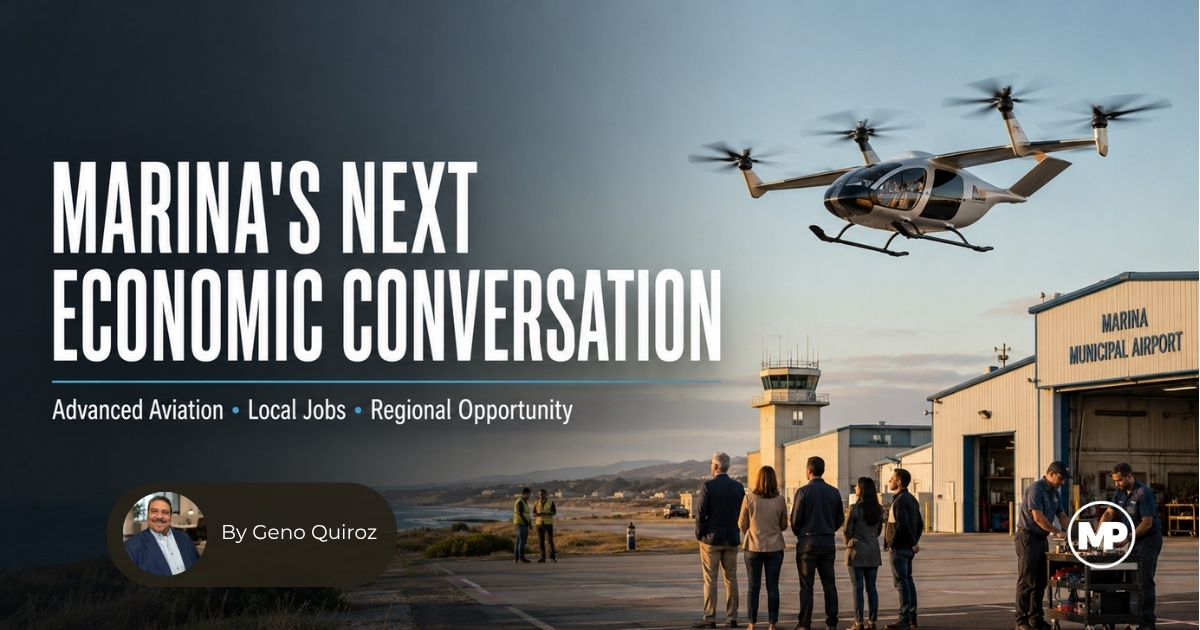
How Joby Aviation, Archer Aviation and a growing advanced-air-mobility corridor could help Marina and the Monterey Bay region build an economy for the next generation.
There is no shortage of local issues for Marina’s leaders and residents to debate.
The City’s Talk of the Town page offers a useful picture of the major conversations already taking place. Marina voters are considering how to fund 911 emergency response, public safety and community services through Measure Q.
The City is moving forward with the Aquatic and Recreation Center, exploring the future of the Equestrian Center, renovating athletic fields and developing new parks. At the same time, Marina is fighting the proposed CalAm desalination project, planning improvements along Del Monte Boulevard and Reservation Road, and confronting questions about traffic safety, aging facilities and the responsible use of public funds.
These are real issues that affect our neighborhoods, our families and Marina’s quality of life. We need to discuss them, understand their costs and decide how limited public dollars should be spent.
But sometimes I wonder whether we have become so focused on how to divide the resources we have today, or how to ask residents for a little more, that we are failing to have a larger conversation about how Marina can create more opportunity and a stronger tax base tomorrow by building jobs in addition to all these new homes and hotels.
That is the larger conversation I would like to hear our city leaders, candidates and business community begin having.
eVTOL: One Opportunity Among Many Worth Exploring
This is not the only path toward Marina’s economic future, nor is it intended to be a complete economic-development plan. It is simply one promising opportunity among many real possibilities that I would love to hear our city officials, candidates and community leaders discussing with greater vision and excitement.
As a former president of the Marina Chamber of Commerce, serving both before and throughout the COVID-19 pandemic, a local business owner, and someone who cares deeply about this community, I believe Marina has far more economic potential than many of us realize. One example is already sitting in plain sight at Marina Municipal Airport.
The Future of Flight Is Already Taking Shape in Marina
Joby Aviation’s presence extends far beyond leasing space at Marina Municipal Airport. According to the company’s 2025 annual filing, Joby uses its Marina facilities to design, manufacture, assemble and test aircraft components, systems and complete aircraft as it works toward FAA certification of its all-electric vertical takeoff and landing aircraft.
Once fully operational, Joby expects its expanded Marina site to have the capacity to produce up to 24 aircraft annually. The site also supports conforming ground and flight testing, pilot-training simulators, aircraft maintenance and Joby’s initial FAA production-certification efforts. As production increases, Joby has said it plans to add hundreds of full-time jobs at the Marina facility.
Just a short distance away, Archer Aviation, one of Joby’s most credible American competitors, is conducting flight-test operations from Salinas Municipal Airport. In July 2026, Archer’s Midnight aircraft completed a piloted round trip between Salinas and Monterey Regional Airport, with each leg taking approximately nine minutes.
Think About What that Could Mean for Monterey County and Marina
Two of the most prominent companies in the emerging electric vertical takeoff and landing industry, commonly called eVTOL, are developing and demonstrating their aircraft in the same relatively small region.
Joby is building and testing in Marina. Archer is testing in Salinas. Monterey Regional Airport offers commercial connectivity and has already participated in flights by both companies. In August 2025, Joby completed a piloted flight from Marina to Monterey. In July 2026, Archer completed a piloted round trip between Salinas and Monterey. Watsonville, Hollister and other nearby airports are part of a developing advanced-air-mobility corridor. Our colleges and workforce organizations are beginning to prepare local residents for advanced-manufacturing and aviation careers.
This is no longer just an interesting technology story. It is a regional economic-development opportunity.
We May Be Looking at the Beginning of an Industry Cluster
When people hear “air taxi,” they may picture wealthy passengers flying over traffic in Los Angeles, New York or Dubai. Those may indeed become important early markets, but that is not the only way communities benefit from a new transportation industry.
The places where passengers eventually buy rides are not necessarily the places where the aircraft are designed, built, tested, certified, maintained and improved.
Marina does not need to become Los Angeles to benefit from advanced aviation. We can become part of the workshop, laboratory and workforce pipeline behind it.
The Monterey Bay region already possesses many of the building blocks needed to support a potential advanced-aviation industry cluster:
- Joby’s manufacturing, aircraft assembly, flight-testing, pilot-training and maintenance operations in Marina
- Archer’s flight-testing operations in Salinas
- Monterey Regional Airport’s commercial-airport capabilities and experience integrating eVTOL flights into FAA-controlled airspace
- Public airports in Watsonville and Hollister that can contribute additional testing and corridor capacity
- Naval Postgraduate School aviation, autonomous-systems and research resources
- Colleges and workforce-development organizations preparing residents for careers in advanced manufacturing, drones and aerospace
- Relative proximity to Silicon Valley’s engineering talent, technology companies and investment community
- Monterey’s established hospitality, tourism and conference economy
The California Advanced Air Mobility Corridors Initiative makes this opportunity even more tangible. The initiative is supported by a $7.45 million California Jobs First grant awarded to the Monterey Bay Economic Partnership on behalf of the Monterey Bay Tech Hub. It is intended to connect the public airports in Watsonville, Marina, Salinas and Hollister through an FAA-compliant multi-airport flight-corridor network. The proposed network would support the testing, certification and commercialization of clean-energy aircraft for passenger transportation, cargo, defense and next-generation drone operations.
That is a much larger story than one company or one type of aircraft.
Joby Could Become One of Marina’s Economic Pillars, But Our Vision Should Be Bigger Than Joby
Marina should be proud that Joby chose to establish such an important part of its operation here. The company brings private investment, skilled employment and national attention to an airport that grew out of the former Fort Ord.
If Joby successfully completes certification and expands commercial production, it could become one of several important economic pillars supporting Marina’s future. Its presence can generate demand for construction, equipment services, utilities, security, hospitality, workforce training, professional services and other forms of local economic activity.
But Joby should be part of Marina’s economic-development strategy, not the entirety of it. A resilient local economy cannot depend too heavily on the success of one company, particularly in an emerging industry where certification, technology and market conditions are still evolving. Marina should use Joby’s presence as a starting point for attracting additional aviation, advanced-manufacturing, technology and supporting businesses.
Why Archer’s Presence in Salinas Matters to Marina
It demonstrates that Joby is not operating in an isolated experiment. The larger region appears to possess qualities that advanced-aviation companies value, including a network of public airports, access to controlled airspace, varied testing environments, nearby research and technology talent, and a diverse regional workforce.
Nationally, Joby and Archer are competitors. Locally, the presence of both could make our entire region more valuable.
The goal should not be to choose sides. It should be to build an ecosystem that attracts suppliers, training programs, maintenance operations, battery specialists, autonomous-aircraft developers, aerospace startups and other employers, regardless of which aircraft manufacturer ultimately leads the market.
Imagine what could happen if city officials and business leaders from Marina, Salinas, Monterey and throughout the county regularly came together around long-term economic opportunities like this one. By recognizing the different strengths each community contributes, we could attract investment, employers and career opportunities that benefit the entire county.
That is how the presence of one promising employer can help a region develop a durable economic sector.
What This Could Mean for Local Workers
Economic development is only meaningful if local families can participate in it.
Advanced aviation will require engineers and executives, but it will also need manufacturing technicians, aircraft mechanics, composite-material specialists, quality inspectors, machinists, electricians, equipment technicians, pilots, instructors, safety personnel and facilities teams.
These can be stable, skilled careers that do not require every young person to leave Monterey County or follow a traditional four-year university path.
Encouragingly, some of this work has already begun. The DART–Joby Advanced Manufacturing Apprenticeship Program has helped local residents enter advanced-manufacturing careers. More than 90% of participating apprentices reportedly transitioned into permanent Joby positions as technicians, inspectors and supervisors.
The region is now building additional pathways. A new Aircraft Maintenance Technician Apprenticeship offers paid, on-the-job training aligned with the FAA Airframe and Powerplant certification exams. DART and Pajaro Valley High School have also established an aircraft build lab where students gain hands-on experience by constructing a full-scale RV-12 airplane.
Meanwhile, DART and Hartnell College are developing a regional drone and aerospace workforce initiative intended to serve residents across Monterey, Santa Cruz and San Benito counties. Monterey Peninsula College is participating through planned drone pathways at its Seaside and Marina campuses, while UC Santa Cruz is supporting aviation research, drone education and the regional advanced-air-mobility test ecosystem.
These programs demonstrate that regional coordination is possible. They also give us something practical to build upon.
Imagine what could happen if our high schools, Hartnell College, Monterey Peninsula College, California State University Monterey Bay, Cabrillo College, local unions, workforce organizations and aerospace employers aligned their efforts around a long-term regional aviation strategy.
We could introduce students to aerospace and robotics before graduation. We could expand paid apprenticeships, help adults transition into new careers and prepare local contractors to serve aviation clients. We could develop maintenance, battery, composite-repair and advanced-manufacturing programs that remain valuable even as individual companies and technologies change.
That is how this opportunity becomes community building, not simply corporate growth.
What This Could Mean for Local Businesses
Most Marina businesses will never manufacture an aircraft, and they do not need to.
New industries generate layers of demand around them. Facilities must be built and maintained. Specialized electrical systems and charging infrastructure must be installed. Visiting engineers, regulators, investors and customers need hotels, meals, transportation and meeting space. Employees need homes, childcare, healthcare and everyday services.
Opportunities may develop for:
- Construction, electrical, HVAC and fire-protection contractors
- Security, access-control and emergency-planning providers
- Equipment rental, trucking and specialized transportation
- Industrial cleaning and environmental services
- Recruitment, staffing and employee relocation
- Hotels, restaurants, caterers and event producers
- Legal, accounting, insurance and compliance professionals
- Photographers, filmmakers, designers and communications firms
- Website, software, cybersecurity and data-service providers
- Aircraft maintenance, battery inspection and composite repair
- Precision machining, specialized tooling and nondestructive inspection
- Flight simulation, pilot training and aviation education
Some opportunities will come directly from companies such as Joby or Archer. Many others will come through their contractors, suppliers, employees, public partners and visiting teams.
Local businesses will not automatically receive that work, however. They need help understanding future procurement needs, obtaining appropriate certifications and building the right relationships before contracts are awarded elsewhere.
That is an area where a chamber of commerce, city economic-development team or regional business coalition could provide real value.
Marina Airport Should Be Viewed as an Economic Asset
Marina Municipal Airport should not be treated simply as leftover land or a passive real-estate holding. It is specialized infrastructure with a history, a purpose and increasingly rare development potential.
The airport connects Marina’s military legacy to a new generation of aerospace, defense and transportation technology. That does not mean every proposal should be approved or that environmental, safety and neighborhood concerns should be ignored. Responsible growth requires public involvement, careful planning and honest answers.
It does mean we should understand the value of what we have before short-term decisions limit its long-term possibilities.
Airport planning should consider power capacity, charging infrastructure, hangars, road access, emergency response, compatible nearby land uses, workforce transportation and room for complementary aviation companies. It should also consider how the airport connects economically with the rest of Marina, so that growth behind the fence supports businesses and residents throughout the city.
We should be asking whether Marina can use Joby’s presence to attract suppliers, complementary employers and other advanced-aviation companies.
We should be asking what kinds of training our residents will need five and ten years from now.
We should be asking how Marina can work with Salinas, Monterey, Watsonville and Hollister rather than viewing every economic opportunity as a competition between neighboring cities.
We should be asking how new investment can strengthen city revenues while preserving the character and diversity of our community.
A Regional Opportunity Requires Regional Cooperation
Each community has a different strength to contribute.
Marina could become a center for manufacturing, certification-related testing, pilot training and aircraft maintenance. Salinas can expand its role in flight testing, operations and workforce access. Monterey can offer a commercial airport, hospitality, conferences and executive connectivity. Watsonville and Hollister can contribute airport capacity and corridor connections. Santa Cruz County can add engineering, software, research and access to Silicon Valley.
None of these communities needs to do everything.
Together, however, they could form a nationally significant advanced-aviation development corridor.
That will require cooperation among cities, airports, educational institutions, workforce organizations, business groups and private companies. It will require leaders who can think beyond the next budget cycle and beyond municipal boundaries.
Regional cooperation does not diminish Marina’s role. It makes Marina’s assets more valuable.
Hope Is Not the Same as Hype
We should approach this opportunity with optimism, but also with honesty.
Neither Joby nor Archer has completed every step required for unrestricted commercial passenger service in the United States. Aircraft certification is costly and difficult. Timelines have changed before and may change again. Battery technology, infrastructure, public acceptance and the economics of everyday air-taxi service still need to be proven at scale.
Large-scale manufacturing could also migrate toward states offering cheaper land or stronger incentives. High-paying employment could intensify local housing pressure if we fail to plan for it. Public investment should not depend on a single company succeeding.
These risks are reasons to build a broad strategy, not reasons to ignore the opportunity.
Hope is not pretending that success is guaranteed. Hope is recognizing a real possibility and doing the serious work required to prepare for it.
The Conversation Marina’s Leaders Should Be Having
As local candidates and public officials discuss Marina’s future, I would like to hear them address questions such as:
- What is Marina’s long-term economic vision for the airport and surrounding lands?
- How are we working with Joby to help local residents and businesses participate in its growth?
- What other aviation, robotics, defense, battery and advanced-manufacturing companies could Marina attract?
- How will our schools and colleges prepare residents for the jobs this sector could create?
- What infrastructure investments will the airport need over the next decade?
- How will Marina collaborate with Salinas, Monterey, Watsonville and Hollister on the regional flight corridor?
- How can new economic activity increase city revenue without sacrificing responsible planning or community trust?
- How will we protect Marina from becoming dependent on a single employer?
These are not partisan questions. They are community-building questions.
We should still debate the facility, the street project and the immediate budget decision. Local government must deal with today’s needs.
But leadership also means looking beyond the next meeting and asking what kind of city we want Marina to become.
Marina Can Help Build the Future
For decades, people have spoken about the economic possibilities left behind by the closure of Fort Ord. We now have an opportunity to write a different chapter, not by recreating the past, but by connecting our history of aviation and military service to an emerging industry.
Joby gives Marina a significant foothold in advanced aviation and the potential to develop one of the city’s important economic pillars. Archer strengthens the regional ecosystem through its operations in Salinas. Monterey Regional Airport connects these developing technologies with the existing aviation system, while the multi-airport corridor gives neighboring communities a framework for working together
We do not yet know exactly how large the eVTOL industry will become or which companies will ultimately succeed. But Marina does not need perfect certainty before it begins preparing.
We can build workforce pathways. We can support local businesses. We can protect and improve the airport. We can recruit complementary employers. We can plan for housing and infrastructure. We can insist on responsible development while still welcoming innovation.
Most importantly, we can begin talking about economic growth with the imagination this moment deserves.
Marina’s future should not be limited to finding a few more dollars for the next project. We should be asking how our community can participate in building an entirely new industry.
The future of flight is already taking shape above us.
The question is whether we will build a future around it here on the ground.
Sources and Further Reading
- Joby expands manufacturing capacity in Marina and Ohio
- Archer completes piloted Salinas–Monterey round trip
- Monterey Bay Economic Partnership: California Advanced Air Mobility Corridors Initiative
- DART: Monterey Bay advanced-air-mobility investment and workforce history

Geno Quiroz serves on the Marketing & Technology team at IPX1031, a Fidelity National Financial company and a national leader in 1031 tax-deferred exchange services. In his current role, Geno focuses on website architecture, design, development, SEO/AIO, and digital marketing strategy. His work helps strengthen the company’s digital presence, improve user experience, and ensure that IPX1031’s online platforms effectively support client engagement and long-term growth.
Concurrently, Geno continues to lead Monterey Premier, the web design and strategic consulting firm he founded in 2015. Through Monterey Premier, he partners with entrepreneurs, nonprofits, and growing organizations to design high-performance websites, refine digital sales funnels, and implement conversion-focused strategies.
His hands-on experience building and scaling a client-facing agency has provided him with a real-world understanding of growth strategy, brand positioning, and the operational realities of business ownership — experience that now directly informs and strengthens his work in enterprise marketing technology.