
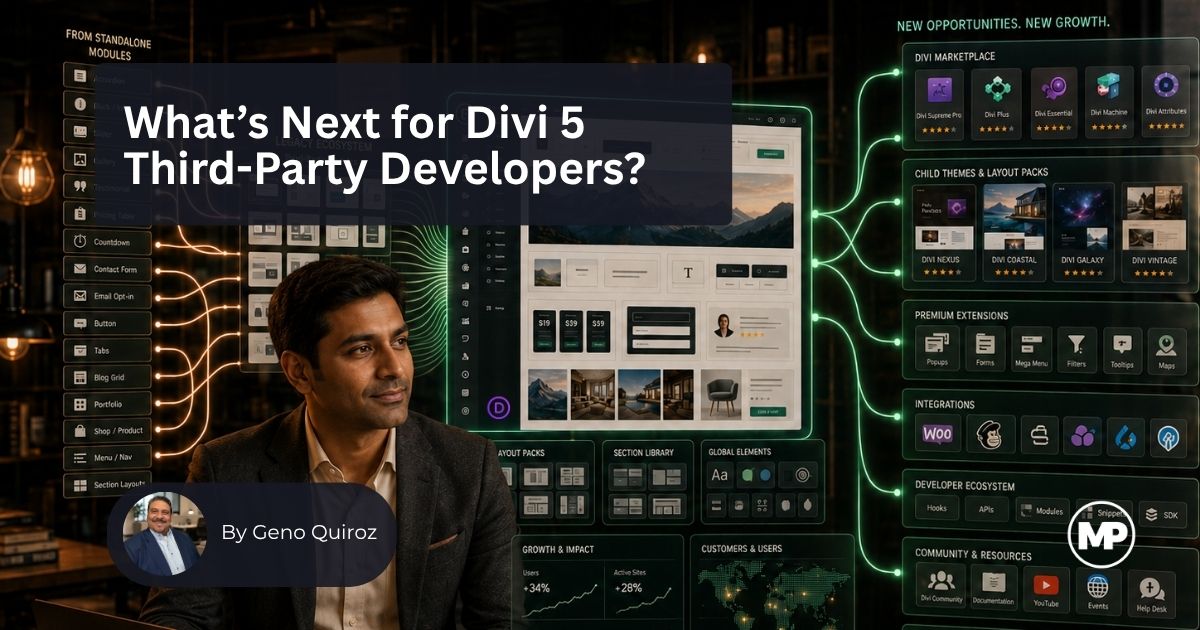
I have seen the question come up several times lately: What’s next for Divi third-party developers? I understand why people are asking. I was one of the early third-party product creators in the Divi community, and I know what it feels like to build something around a platform you do not control.
Now Divi 5 is rolling out native features at a pretty incredible pace, including features that third-party developers spent years creating solutions for. That can be unsettling if your business depends on one of those products.
But after spending some time putting myself back in those shoes, I do not think this is the end of the Divi third-party ecosystem. I think it is another one of those moments when good entrepreneurs look at where the market is going, adjust early, and build the next thing people are going to need.
Why Divi 5 Third-Party Developers Are Asking “What’s Next?”
The concern is understandable because Divi 5 is increasingly turning common custom-code and third-party workflows into native functionality.
Divi 5 officially moved beyond beta in 2026, and Elegant Themes has continued releasing new features rapidly. More recently, its new Post Filter functionality made it possible for users to search, filter, sort, and reorder Divi loops from the front end, including querying taxonomies and custom fields.
If you are a Divi user, that is great news.
If you spent the last several years selling a product that solved one of those problems, however, I understand why it might feel a little different.
We have watched Divi gain native capabilities around loops, carousels, menus, breadcrumbs, SVGs, tables of contents, timelines, tooltips, advanced layout controls, conditional functionality, dynamic content, design systems and much more.
Some functionality that once required an add-on simply does not anymore.
But I think there is an important distinction here:
The need for some third-party products may shrink. The need for third-party expertise is not shrinking.
In many ways, it may be growing.
Divi 5 Third-Party Developers Need to Remember the Risk of Building on Someone Else’s Platform
One of the most important business lessons I have learned is that whenever you build your business around somebody else’s product, there is always platform risk.
I wrote about this recently in my article, 5 Divi 5 Features I Absolutely Love After More Than a Decade With Divi. Years ago, I began seeing Elegant Themes incorporate capabilities and workarounds into Divi that people like me had previously been teaching or building ourselves.
I did not see that as a bad thing. In many ways, it validated that we had discovered genuine needs in the community.
But it taught me something.
You Can Own the Business Without Owning the Platform
If your business depends on WordPress, Divi, WooCommerce, Shopify, Facebook, Google, Amazon, Apple or almost any other technology platform, someone else controls part of your future.
They can:
- Add your feature to the core product.
- Change an API.
- Change marketplace terms.
- Change pricing.
- Change technology.
- Change their algorithm.
- Acquire a competitor.
- Build something better.
- Decide to head in another direction entirely.
That does not mean you should never build on another platform.
It means your product should never be your only asset.
Your expertise, reputation, customers, mailing list, community, brand, relationships and ability to solve problems are assets too.
And unlike a single module, those assets can travel with you.
That lesson was one reason I ultimately closed my own Monterey Premier Divi Marketplace as Elegant Themes prepared to build its marketplace. Instead of trying to compete against the platform owner, I decided my time was better spent elsewhere.
Looking back, I am glad I made the pivot when I did.
Divi Third-Party Developers Should Use What They Built as a Launching Pad
If you successfully created and sold a Divi product, do not look at that experience as something that suddenly became less valuable. Look at everything you proved you could do.
This is probably the first thing I would tell a younger developer sitting across the table from me.
You built something people were willing to pay for.
That is a big deal.
Think about what creating a successful Divi product required:
- You identified a market need.
- You built a solution.
- You learned Divi and WordPress development.
- You tested and debugged software.
- You created documentation.
- You launched a product.
- You marketed it.
- You supported customers.
- You handled updates.
- You built a reputation.
- You may have created recurring revenue.
- You developed a user base.
That is not merely, “I made a Divi plugin.”
That is business experience.
Update the Way You Describe Yourself
If I were making this pivot today, one of my first stops would be LinkedIn, my website and my professional bio.
Instead of:
Developer of XYZ Divi Module
Think:
WordPress product developer who identified an underserved market, developed and launched a commercial software product, grew a user base and supported customers throughout the product lifecycle.
Same experience.
Completely different perception.
That positioning can open doors into:
- WordPress product development.
- SaaS companies.
- Agency development.
- Product management.
- UX engineering.
- Developer relations.
- Technical marketing.
- Consulting.
- Training.
- Enterprise web teams.
- Entrepreneurship.
Your old product may eventually become obsolete.
The experience you gained building it does not.
Divi 5 Developer Business Models Should Move Beyond Standalone Modules
A changing product environment is also a good time to ask a bigger question: What part of this business did you actually enjoy?
That question has guided most of my own pivots.
For me, the answer was never simply “selling modules.”
I liked solving problems. I liked building websites. I liked marketing. I liked teaching. I liked working with business owners and helping them understand technology.
So over time, my business model evolved around those things.
Turn the Part You Enjoy Into the Next Revenue Stream
| If You Enjoyed… | Consider Building Toward… |
|---|---|
| Coding | Advanced integrations, custom development, SaaS or specialized plugins |
| Designing | Premium Divi builds, templates, design systems or agency services |
| Teaching | Courses, workshops, tutorials or certification programs |
| Helping customers | Consulting, implementation or technical support services |
| Marketing | Product marketing, affiliate content, SEO or developer relations |
| Community | Memberships, coaching programs or paid communities |
| Troubleshooting | Divi migrations, audits, performance optimization or support retainers |
| Building systems | Agency tools, workflow products and automation |
| Working with businesses | Vertical-specific Divi solutions and consulting |
In my case, website design remained the core because I genuinely enjoyed doing it. The difference is that years of experience allowed me to move further upmarket and charge considerably more for that work.
The same happened with consulting and coaching. Once you have spent years solving real problems, you discover that people are sometimes willing to pay several hundred dollars for an hour of your experience because they are not paying for sixty minutes.
They are paying to avoid sixty hours, or sixty days, of figuring it out themselves.
I also discovered that I enjoyed the marketing and technology side enough to eventually accept a full-time role working on websites and digital strategy for a Fortune 500 organization.
I still get to build.
I still get to run my business.
I still get to work with Divi.
The path simply looks different than it did fifteen years ago.
Divi 5 Third-Party Products Can Extend Native Features Instead of Replacing Them
This may be the most interesting opportunity for developers who still love building products: stop asking which Divi feature you can recreate and start asking what you can build on top of it.
Elegant Themes appears to be creating room for exactly that.
Its Divi 5 developer updates include hooks allowing third-party plugins to extend Loop Builder queries with custom attributes, introduce custom Conditional Display conditions, react when content changes in the Visual Builder, detect saves and add custom interfaces and panels.
That changes the opportunity.
Instead of Replacing Divi, Extend Divi
Suppose Divi now has a native Post Filter.
Do not immediately conclude:
Well, nobody needs filtering plugins anymore.
Ask:
- What complex filtering scenarios cannot it handle yet?
- What industry-specific queries could be added?
- Could it connect to external databases?
- Could filtering integrate with maps?
- Could it support specialized WooCommerce applications?
- Could AI generate or modify queries?
- Could agencies manage query systems across hundreds of sites?
- Could reporting be layered on top?
- Could accessibility be improved?
- Could advanced analytics track how visitors use those filters?
That is a very different product-development mindset.
The native feature becomes infrastructure.
You build the specialized layer above it.
And I would much rather own the specialized solution to a valuable business problem than compete with Elegant Themes over who has the better basic accordion module.
Divi Third-Party Ecosystem Opportunities Are Moving Toward Specialized Problems
As Divi becomes more capable out of the box, I believe the strongest third-party opportunities will increasingly exist farther away from basic page-building functionality.
That is actually healthy for the ecosystem.
In my previous article, I identified several areas where I believe opportunity remains, including advanced integrations, specialized business systems, industry-specific solutions, training, migrations, workflow tools, accessibility, performance, AI and consulting.
I would go even further now.
1. Industry-Specific Divi Solutions
Stop building for “anyone who uses Divi.”
Build for:
- Real estate companies.
- Dentists.
- Law firms.
- Churches.
- Restaurants.
- Membership organizations.
- Home-service companies.
- Ecommerce companies.
- Schools.
- Nonprofits.
A generic directory module is easier for Divi to eventually replicate.
A complete real estate property-management workflow built around Divi is much harder.
2. Deep Third-Party Integrations
Divi does not need to become every other software platform.
That leaves opportunities around connecting Divi to:
- CRMs.
- Marketing automation platforms.
- Learning management systems.
- Membership platforms.
- Ecommerce systems.
- Booking applications.
- Real estate databases.
- Business intelligence tools.
- AI services.
- Industry-specific APIs.
3. Agency Workflow Products
Divi 5 is increasingly becoming a design system rather than merely a page builder.
That creates opportunities for tools that help agencies manage:
- Design standards.
- Component libraries.
- Client approvals.
- Content workflows.
- Site audits.
- Accessibility.
- QA.
- Deployment.
- Maintenance.
- Multisite environments.
- Reporting.
4. AI-Powered Divi Workflows
The question is not simply whether Divi itself adds AI.
Ask where AI can remove friction from the user’s overall workflow.
There may be opportunities around:
- Content architecture.
- SEO.
- Schema.
- Accessibility audits.
- Custom code generation.
- Design-system creation.
- Component recommendations.
- Troubleshooting.
- Client onboarding.
- Documentation.
- Site migration.
The farther you move toward solving a business problem instead of merely adding a builder feature, the harder you become to replace.
Divi 5 Third-Party Developers Can Turn Expertise Into Training, Consulting and Community
Another lesson I have learned is that when software becomes more powerful, it usually does not eliminate experts. It creates demand for people who know how to use that power.
Divi 5 is a good example.
Flexbox, CSS Grid, Groups, Nested Elements, Design Variables, Presets, Loops, Conditional Display, interactions and all these new modules give users significantly more control.
They also give users significantly more to learn.
That is an opportunity.
Josh Hall Is a Great Example of Following the Need
My friend Josh Hall‘s career is worth studying here.
Josh entered the Divi community, began contributing to the Elegant Themes blog and launched a regular Divi tutorial series. He eventually expanded from Divi tutorials into broader web design education, courses, business coaching, a podcast and community.
He later sold his web design agency so he could focus on education full-time and continued building a much broader business around helping web designers grow successful careers and companies.
I love that story because Josh did not have to abandon Divi to grow beyond Divi tutorials.
He used what he learned inside the ecosystem as the launching pad for something bigger.
That same opportunity exists today.
You could create:
- Divi 5 beginner courses.
- Advanced Divi development training.
- Divi 4-to-5 migration services.
- Agency implementation workshops.
- Private consulting.
- Developer coaching.
- Vertical-specific Divi training.
- Membership communities.
- YouTube channels.
- Documentation services.
- Divi certification preparation.
- Corporate training.
Sometimes the most valuable product you have left to sell is everything you learned building the first product.
Divi Third-Party Developers Should Use Their Existing Customers as Market Research
If you already have hundreds or thousands of Divi customers, you possess something that a new entrepreneur would love to have: direct access to a proven market.
Do not waste that.
Before deciding what to build next, talk to them.
Not with a twenty-question corporate survey nobody wants to complete.
Have conversations.
Ask Your Divi Customers What Has Changed
- What are you excited about?
- What are you confused about?
- What are you still struggling to accomplish?
- Which plugins do you still consider essential?
- What are you removing?
- What takes too much time?
- What are your clients requesting?
- What would you happily pay somebody else to handle?
- What are you doing outside Divi that you wish worked inside Divi?
Then listen for patterns.
This is how the original Divi third-party ecosystem grew in the first place.
We saw people asking for things.
We figured out how to build them.
We shared the solution.
Somebody said, “Can you do that for me?”
A market was born.
That fundamental process has not changed. The needs have.
The Divi 5 Third-Party Ecosystem Needs Developers Willing to Pivot Early
One of the benefits of having been in business for a while is that you eventually stop being quite so afraid of pivots.
They happen.
Markets change.
Technology changes.
Customers change.
Companies change.
And sometimes the business model that worked brilliantly five years ago stops making sense.
The worst thing you can do is hold onto it simply because you invested years building it.
I try to watch where things are headed and move before I am forced to.
That was part of the thinking behind closing my Divi marketplace before Elegant Themes launched its own marketplace. I did not see much wisdom in positioning myself to compete directly against the company that owned the platform.
Instead, I leaned further into the things they were unlikely to replace:
- My experience.
- My client relationships.
- My consulting.
- My website design work.
- My marketing knowledge.
- My ability to solve complicated business problems.
That pivot worked for me.
Your pivot probably will not look exactly like mine.
It shouldn’t.
Do Not Ask Only, “How Do I Save This Product?”
Ask:
Knowing everything I know today, what would I build if I were starting again?
That question can lead somewhere very different.
What I Would Do as a Divi 5 Third-Party Developer Today
If I woke up tomorrow and still owned a Divi product company, I would not panic. I would spend the next few months deliberately repositioning around the opportunities Divi 5 is creating.
Here would be my basic plan:
| Step | What I Would Do | Why |
|---|---|---|
| 1. Audit | Compare every product against Divi 5’s native roadmap | Identify real platform risk |
| 2. Listen | Interview current customers | Discover emerging needs |
| 3. Extend | Look for ways to enhance native Divi features | Build with Divi instead of against it |
| 4. Specialize | Pick industries or advanced use cases | Reduce commoditization |
| 5. Diversify | Add services, consulting or training | Reduce dependence on product revenue |
| 6. Position | Update my personal and company brand | Turn past product success into authority |
| 7. Build Community | Invest in customers, email and relationships | Own the audience even when platforms change |
| 8. Experiment | Launch small solutions before large products | Follow demand instead of assumptions |
| 9. Watch Divi | Follow Elegant Themes’ roadmap closely | Avoid building something about to become native |
| 10. Pivot Early | Move when the direction becomes clear | Do not wait for revenue to disappear |
Most importantly, I would stop measuring the future of my business by how many modules Elegant Themes adds.
I would measure it by how many problems Divi users still have.
Because there will always be problems to solve.
The Future for Divi 5 Third-Party Developers May Be Bigger Than Modules
I do not think Divi 5 is killing the third-party ecosystem.
I think it is maturing it.
Elegant Themes should keep improving Divi. That is what we want them to do. If the community discovers features users desperately want, we should expect some of the best ideas to eventually become native.
That is part of building around someone else’s platform.
Our job as entrepreneurs is not to ask the platform owner to stop innovating so our existing products remain necessary forever.
Our job is to keep finding the next need.
The Divi ecosystem originally grew because independent developers, designers, educators and entrepreneurs paid attention to what users were trying to accomplish and stepped into the gaps.
That opportunity has not disappeared.
The gaps have simply moved.
And for some of the younger developers and entrepreneurs wondering what comes next, I would encourage you not to see that as bad news.
You already learned how to build.
You already learned how to solve problems.
You already learned how to serve a community.
Take those skills with you into whatever comes next.
Do not be afraid to pivot. Do not be afraid to build something different. And most importantly, do not confuse the end of one product opportunity with the end of your opportunity.
There is still plenty of room to build the next chapter of the Divi ecosystem.

Geno Quiroz serves on the Marketing & Technology team at IPX1031, a Fidelity National Financial company and a national leader in 1031 tax-deferred exchange services. In his current role, Geno focuses on website architecture, design, development, SEO/AIO, and digital marketing strategy. His work helps strengthen the company’s digital presence, improve user experience, and ensure that IPX1031’s online platforms effectively support client engagement and long-term growth.
Concurrently, Geno continues to lead Monterey Premier, the web design and strategic consulting firm he founded in 2015. Through Monterey Premier, he partners with entrepreneurs, nonprofits, and growing organizations to design high-performance websites, refine digital sales funnels, and implement conversion-focused strategies.
His hands-on experience building and scaling a client-facing agency has provided him with a real-world understanding of growth strategy, brand positioning, and the operational realities of business ownership — experience that now directly informs and strengthens his work in enterprise marketing technology.