
Walmart’s agreement to acquire Vibe.co may look like another large company buying an advertising platform. It is much bigger than that. Walmart is assembling the data, technology, media inventory, commerce infrastructure, and measurement capabilities needed to become a serious advertising and media technology competitor.
This is not simply a play for more advertising revenue. It is a move toward a connected digital ecosystem in which Walmart can help a brand identify an audience, deliver an ad on streaming television, influence a purchase, and measure the resulting sale.
For business owners and marketing leaders, the broader lesson is clear: the future of digital marketing will not be defined by isolated channels or standalone tools. It will be shaped by integrated digital experiences that connect customer data, media, commerce, analytics, automation, and AI.
The Walmart Vibe Acquisition Is About More Than Advertising
On June 23, 2026, Walmart announced that it had entered into an agreement to acquire Vibe.co, a self-service connected television advertising platform. Walmart said the acquisition would combine Vibe’s technology with Walmart Connect’s commerce audiences, closed-loop measurement capabilities, and growing media ecosystem, including VIZIO. You can read the official Walmart acquisition announcement for more details.

You can read the official Walmart acquisition announcement for more details.
That description is important because it confirms that Walmart is not treating Vibe as a separate advertising tool. The company intends to incorporate it into a broader, full-funnel commerce media strategy.
Vibe essentially makes streaming television advertising function more like a familiar digital advertising platform. Instead of requiring a major television agency, a large production team, and an enterprise-level media budget, businesses can use Vibe to create, launch, manage, and optimize connected TV campaigns through a self-service interface.
The company says its platform has served more than 10,000 advertisers and can reach approximately 120 million households across more than 500 apps and channels. Vibe also announced in 2025 that it had reached $100 million in annual recurring revenue, demonstrating that demand for accessible, performance-based television advertising was already significant before the Walmart agreement.
Industry reporting further demonstrates the scale of Walmart’s ambition. The Wall Street Journal reported that the transaction was valued at approximately $1.4 billion, including a reported $1.2 billion cash payment and retention incentives. Walmart did not publicly disclose the financial terms in its announcement.
This is not Walmart experimenting with another marketing channel. It is Walmart making a substantial investment in becoming a larger advertising and media technology company.
What Vibe CEO Arthur Querou Said About the Deal
Vibe CEO Arthur Querou’s LinkedIn announcement provides helpful context for understanding how the company views the acquisition.
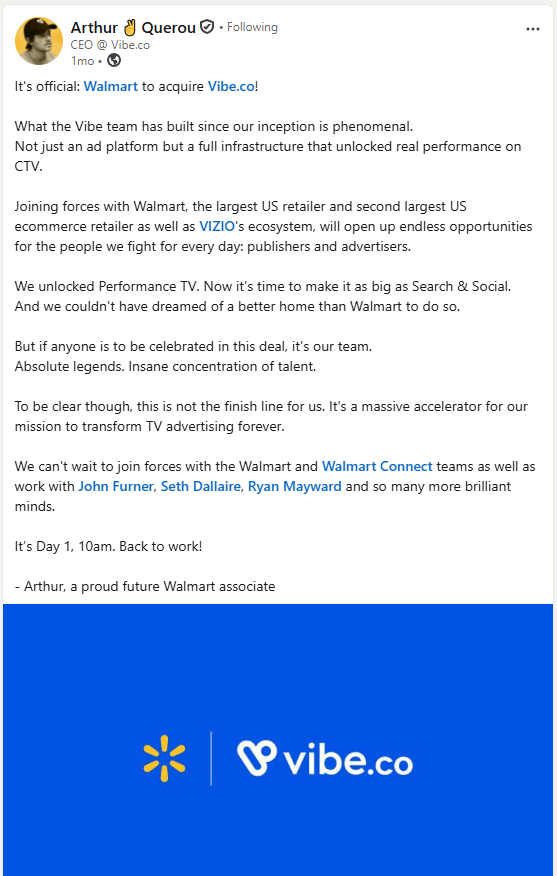
Vibe CEO Arthur Querou’s June LinkedIn announcement
Querou emphasized that Vibe had built “not just an ad platform but a full infrastructure” designed to produce measurable performance through connected television. He also described the Walmart agreement as an accelerator rather than a finish line.
The most revealing part of his post was Vibe’s ambition to make what it calls Performance TV as significant as search and social advertising.
That language matters.
Vibe does not want connected TV to remain primarily an awareness channel measured through impressions and estimated reach. Its vision is to make streaming television function more like Google Ads or Meta Ads, where marketers can launch campaigns, track results, optimize spending, and connect media exposure to measurable business outcomes.
Querou’s announcement therefore supports the larger strategic interpretation of the deal: Vibe sees Walmart’s retail reach, commerce data, Walmart Connect platform, and VIZIO ecosystem as the infrastructure needed to bring performance-oriented television advertising to a much larger market.
Walmart’s Connected TV Advertising Strategy Combines Vibe, VIZIO and Walmart Connect
The Vibe acquisition makes far more sense when viewed alongside Walmart’s previous acquisition of VIZIO.
Walmart completed its $2.3 billion acquisition of VIZIO in December 2024. That deal gave Walmart access not only to a television manufacturer but also to VIZIO’s SmartCast operating system and advertising capabilities. Walmart outlined those capabilities in its VIZIO acquisition announcement.
Each part of Walmart’s developing ecosystem provides a different strategic capability.
VIZIO Provides
- Smart TVs and connected screens
- A television operating system
- Streaming inventory and viewer engagement
- A direct media connection inside the home
Vibe Provides
- Self-service connected TV campaign tools
- Audience and campaign management
- Optimization technology
- Performance measurement capabilities
- Easier access for small and mid-sized advertisers
Walmart Connect Provides
- Walmart commerce audiences
- Online and in-store purchase insights
- Retail media placements
- Audience targeting
- Closed-loop sales measurement
Together, these capabilities begin to form a complete advertising and commerce system.
Walmart has already described this strategy as “content-to-commerce.” During its 2026 IAB NewFronts presentation, Walmart and VIZIO outlined plans to connect storytelling, retail behavior, and closed-loop measurement within one media ecosystem.
The Vibe acquisition adds an important activation layer to that strategy. Walmart may own the audience data, retail relationship, television ecosystem, and measurement capabilities, but advertisers still need a practical way to purchase and manage campaigns. Vibe provides that interface.
AdExchanger’s coverage of the acquisition highlighted Walmart’s opportunity to attract smaller businesses that previously lacked the budgets, tools, or teams needed to invest in connected television.
The resulting system could look something like this:
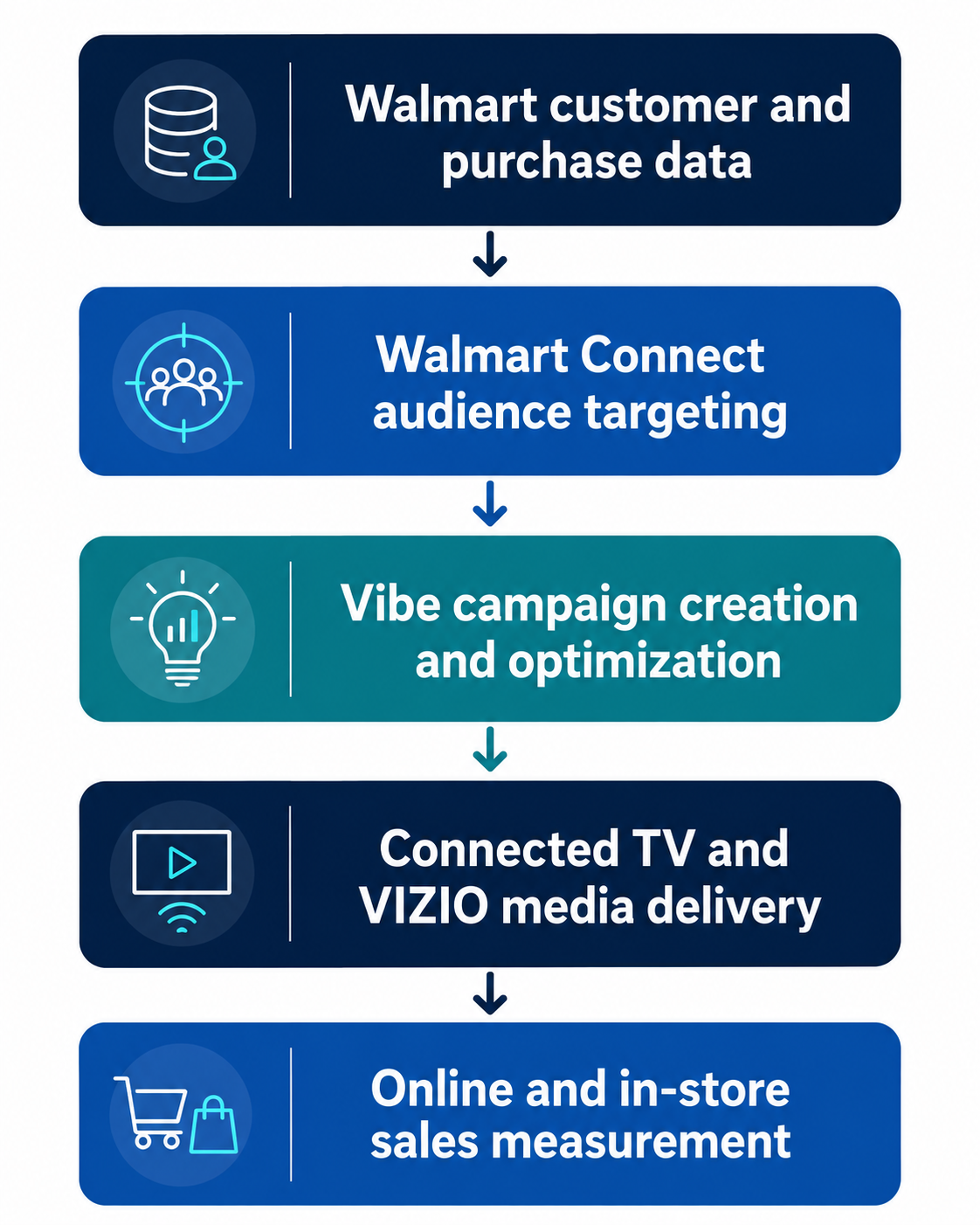
That is much more powerful than simply selling ad space on a television. It is an example of the connected business technology I discussed in Using Technology in Your Business Growth Strategy. Individual platforms become far more valuable when customer data, marketing tools, analytics, and business processes work together.
Why the Walmart Vibe Deal Could Make Streaming TV a Performance Marketing Channel
The phrase Performance TV may be the most important concept behind the acquisition.
Traditional television advertising has generally focused on broad metrics such as:
- Estimated audience size
- Impressions
- Reach
- Frequency
- Brand awareness
Those measurements are valuable, but they do not always answer the question business owners care about most:
Did the advertising produce a measurable business result?
Performance marketing is built around outcomes such as:
- Purchases
- Qualified leads
- Conversions
- Revenue
- Customer acquisition cost
- Return on ad spend
Vibe’s value proposition is that connected television can be planned, purchased, optimized, and measured more like paid search or paid social.
Walmart makes that promise more compelling because of the company’s enormous amount of commerce data.
Consider a sporting goods brand that runs a streaming television commercial for a fishing rod, tent, or camping stove. Through a traditional television campaign, the brand may be able to estimate how many households saw the commercial.
Within Walmart’s developing ecosystem, the advertiser may eventually be able to target relevant shopper audiences, deliver the campaign through connected television, and measure whether exposed customers later purchased the advertised product through Walmart.com or a physical Walmart store.

Marketing Dive: Read more about what Walmart’s Vibe.co deal means for CTV, retail media convergence.
Marketing Dive described the acquisition as part of the convergence between retail media and connected television. That convergence could help Walmart extend its advertising business beyond sponsored product listings and other placements located within Walmart’s own shopping properties.
Closed-loop measurement is the real strategic advantage.
- Google has search intent.
- Meta has social behavior and audience engagement.
- Amazon has product searches, marketplace activity, and purchase data.
- Walmart has purchase data from one of the largest retail operations in the world, along with physical stores, ecommerce, Walmart Connect, VIZIO, and now a self-service connected TV advertising platform.
This also illustrates why websites, SEO, advertising, and customer experience cannot be managed as disconnected projects. As I explain in Website Designer Near Me or Digital Experience Architect?, the real work is not simply designing an attractive interface. It is creating an architecture that connects content, user experience, SEO, technology, and measurable business goals.
What the Walmart Vibe Acquisition Means for the Future of Digital Experiences
The most important takeaway for marketers is not that every business should immediately begin purchasing streaming television ads.
The larger lesson is that digital marketing is moving away from disconnected tools and toward integrated experience ecosystems.
The organizations gaining the strongest competitive advantages are connecting:
- Websites
- Search
- Social media
- Streaming media
- Customer relationship management
- Ecommerce
- Marketing automation
- AI assistants
- Customer service
- Analytics
- Offline transactions
Every interaction creates data that can improve the next interaction. This same pattern is shaping enterprise AI.
The strongest enterprise AI systems are not simply chatbots attached to a website. They are connected to trusted documentation, customer histories, internal workflows, analytics, business rules, and human oversight.
The value is not found in the standalone AI interface. It is found in the complete system surrounding it.
Walmart’s advertising strategy follows the same principle.
- VIZIO alone is a television platform.
- Vibe alone is an advertising platform.
- Walmart Connect alone is a retail media network.
The Future of Digital Marketing Is Connected Digital Experiences
Walmart’s commerce data alone is a valuable source of customer intelligence.
Connected together, however, they become a digital experience and measurement ecosystem that can potentially guide a customer from media exposure to purchase.
That is what business owners and decision-makers should be studying. Most companies will never own a television manufacturer, national retail chain, or advertising exchange. But they can still apply the same strategic thinking to their own websites and marketing systems.
A website should not be treated as a standalone online brochure. It should serve as a trusted digital asset that connects content, search visibility, lead generation, customer data, sales, service, and ongoing measurement. I explore that broader ownership mindset in The Ultimate Guide to Owning a Website.
Visibility is another important part of that connected ecosystem. A sophisticated technology stack does little good when customers and AI-driven search platforms cannot discover or understand your content. My article, Why Is My Website Not Ranking on Google?, explains why technical structure, search intent, ongoing optimization, and AI visibility must be included in the larger digital experience strategy.
Instead of asking only:
What marketing tool should we purchase next?
Business leaders should begin asking:
How will this tool connect with our customer data, website, content, advertising, sales process, service experience, analytics, and AI strategy?
The Bigger Pattern I’m Seeing
Over the past several months, I’ve noticed the same pattern emerging in nearly every major technology announcement I’ve been following.
It doesn’t matter whether the conversation is about AI assistants, retail media, search engines, website strategy, customer service, marketing automation, or enterprise knowledge management.
At first glance, they all seem like different topics. They’re not.
They’re all moving toward the same destination: connected digital ecosystems built around trusted data.
That’s why I don’t actually think this story is about Walmart acquiring an advertising platform. It’s about a much larger shift taking place across every industry.
The companies leading the next generation of digital experiences aren’t simply investing in better websites, better AI tools, or better advertising platforms. They’re connecting every customer touchpoint into a single, intelligent ecosystem where data flows seamlessly between marketing, sales, customer service, analytics, commerce, and AI.
I’ve seen this same pattern while researching enterprise AI assistants, writing about Google’s evolving search experience, exploring AI-powered documentation systems, and helping clients rethink how their websites fit into their broader business strategy. The technology may be different, but the direction is remarkably consistent.
The organizations that will thrive over the next decade won’t necessarily be the ones with the biggest marketing budgets or the newest AI tools.
They’ll be the ones that build trusted digital ecosystems where every customer interaction makes the next one smarter.
To me, that’s the real story behind Walmart’s acquisition of Vibe.
It’s another sign that the future of digital marketing isn’t about individual platforms anymore.
It’s about designing connected digital experiences that deliver measurable business outcomes.
What the Walmart Vibe Acquisition Means for Small Businesses
One of the biggest mistakes I see is business owners assuming these kinds of announcements only matter to Fortune 500 companies.
It is easy to think:
“That is interesting, but I do not have Walmart’s budget, customer data, or advertising platform.”
That is true. Most businesses will never own a retail media network, millions of customer records, or a connected TV advertising platform.
But you do not need to.
The lesson is not to copy Walmart’s technology. It is to adopt Walmart’s way of thinking.
Instead of building disconnected marketing efforts, small and mid-sized businesses can create a connected digital ecosystem where each part of the customer experience supports the next.
Your digital ecosystem might include:
- A website that serves as your digital headquarters
- A CRM that captures, organizes, and nurtures leads
- SEO that attracts qualified visitors through traditional and AI-driven search
- Analytics that connect marketing activity to measurable business outcomes
- AI assistants that improve customer support, internal knowledge, and efficiency
- Email marketing that builds trust and maintains long-term customer relationships
- Marketing automation that delivers the right message at the right stage of the customer journey
- Digital advertising that connects with your website, customer data, and sales process
Individually, each of these tools can provide value.
Connected together, they become something much more powerful: a digital experience ecosystem that improves the customer journey, produces better data, and helps your business make smarter marketing decisions.
That is the same principle behind Walmart’s strategy.
The technology may be different, but the mindset is exactly the same.
The Future of Digital Marketing Is Already Here
The winners in the next era of digital marketing will not necessarily be the companies using the most tools.
They will be the companies building the most connected, trusted, measurable, and useful digital experiences.
Walmart’s acquisition of Vibe is more than another corporate deal. It is another signal that the future belongs to organizations building connected ecosystems where customer data, digital experiences, AI, analytics, commerce, and marketing work together seamlessly.
That shift is already underway. The businesses that recognize it today will be the ones shaping tomorrow’s customer experiences.

Geno Quiroz serves on the Marketing & Technology team at IPX1031, a Fidelity National Financial company and a national leader in 1031 tax-deferred exchange services. In his current role, Geno focuses on website architecture, design, development, SEO/AIO, and digital marketing strategy. His work helps strengthen the company’s digital presence, improve user experience, and ensure that IPX1031’s online platforms effectively support client engagement and long-term growth.
Concurrently, Geno continues to lead Monterey Premier, the web design and strategic consulting firm he founded in 2015. Through Monterey Premier, he partners with entrepreneurs, nonprofits, and growing organizations to design high-performance websites, refine digital sales funnels, and implement conversion-focused strategies.
His hands-on experience building and scaling a client-facing agency has provided him with a real-world understanding of growth strategy, brand positioning, and the operational realities of business ownership — experience that now directly informs and strengthens his work in enterprise marketing technology.